
Situation
The project examined crowded emergency environments where patient journeys, equipment, storage, spatial constraints, and time-sensitive work intersected.
Case study / 05 · Internship concept
A research-led industrial-design concept developed during a Philips internship, translating emergency-ward workflows, ergonomics, product analysis, and broad sketch exploration into a high-fidelity mobile care platform.
Workflow, spatial, and ergonomic research became a high-fidelity modular emergency-care concept.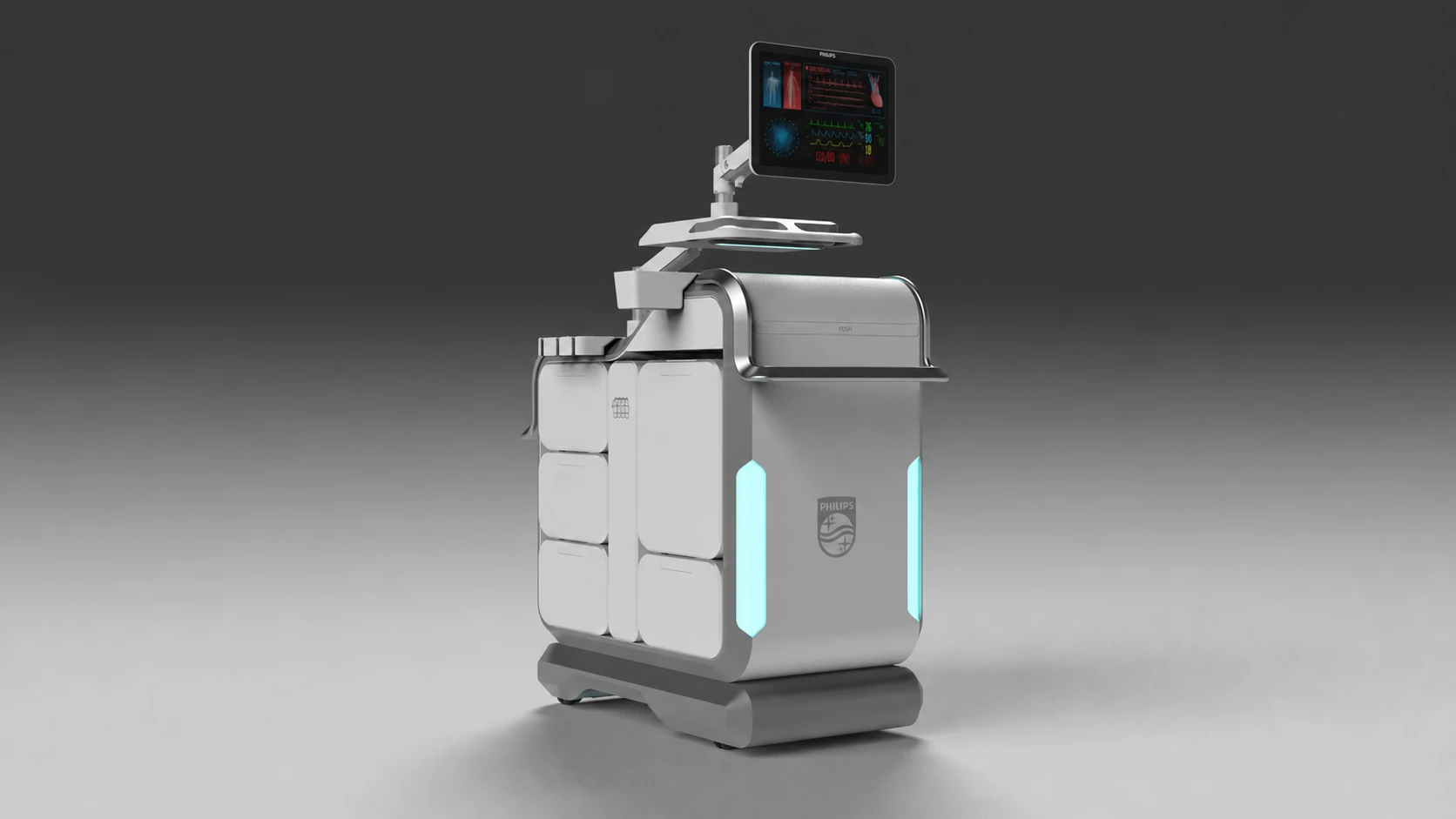
At a glance
Evidence to decision
Emergency-care work brought time pressure, equipment, storage, constrained space, and multiple clinical roles together around the patient.
Patient journeys, an emergency-workflow map, recorded floor-plan dimensions, emergency-cart observation, and product, stakeholder, competitive, and ergonomic analyses defined the opportunity and constraints.
A mobile platform could organise diagnostic, monitoring, storage, and emergency-support functions closer to the patient instead of treating each need as an isolated product or room feature.
Develop Life Shield as a configurable mobile concept with modular storage, articulated display support, oxygen access, multidirectional mobility, and other feature proposals.
A high-fidelity CAD proposal, documented form iterations, feature renders, and conceptual in-context visualisations.
The project produced a resolved industrial-design proposal; no physical prototype, clinician evaluation, engineering validation, manufacturing development, or launch is evidenced.
The project examined crowded emergency environments where patient journeys, equipment, storage, spatial constraints, and time-sensitive work intersected.
Explore how one mobile platform could accommodate multiple Philips healthcare devices and support medical staff during emergency and trauma care.
I led the research synthesis, emergency-workflow and product analysis, ergonomics study, ideation, concept development, CAD, and final visualisation, with mentorship from Mr. Sundarjeeth Jadhav.
The project produced a high-fidelity industrial-design proposal with modular storage, articulated display support, oxygen access, multidirectional mobility, and other feature concepts. It was not presented as a tested, manufactured, or launched product.
Philips Life Shield was a three-month industrial-design internship project completed in 2020. The work explored how a mobile product could bring diagnostic, monitoring, storage, and emergency-support functions closer to clinical teams.
The result is a high-fidelity concept proposal. The source material documents research synthesis, sketches, CAD development, feature definition, and contextual rendering. It does not document a physical prototype, clinician evaluation, engineering validation, manufacturing development, or launch.
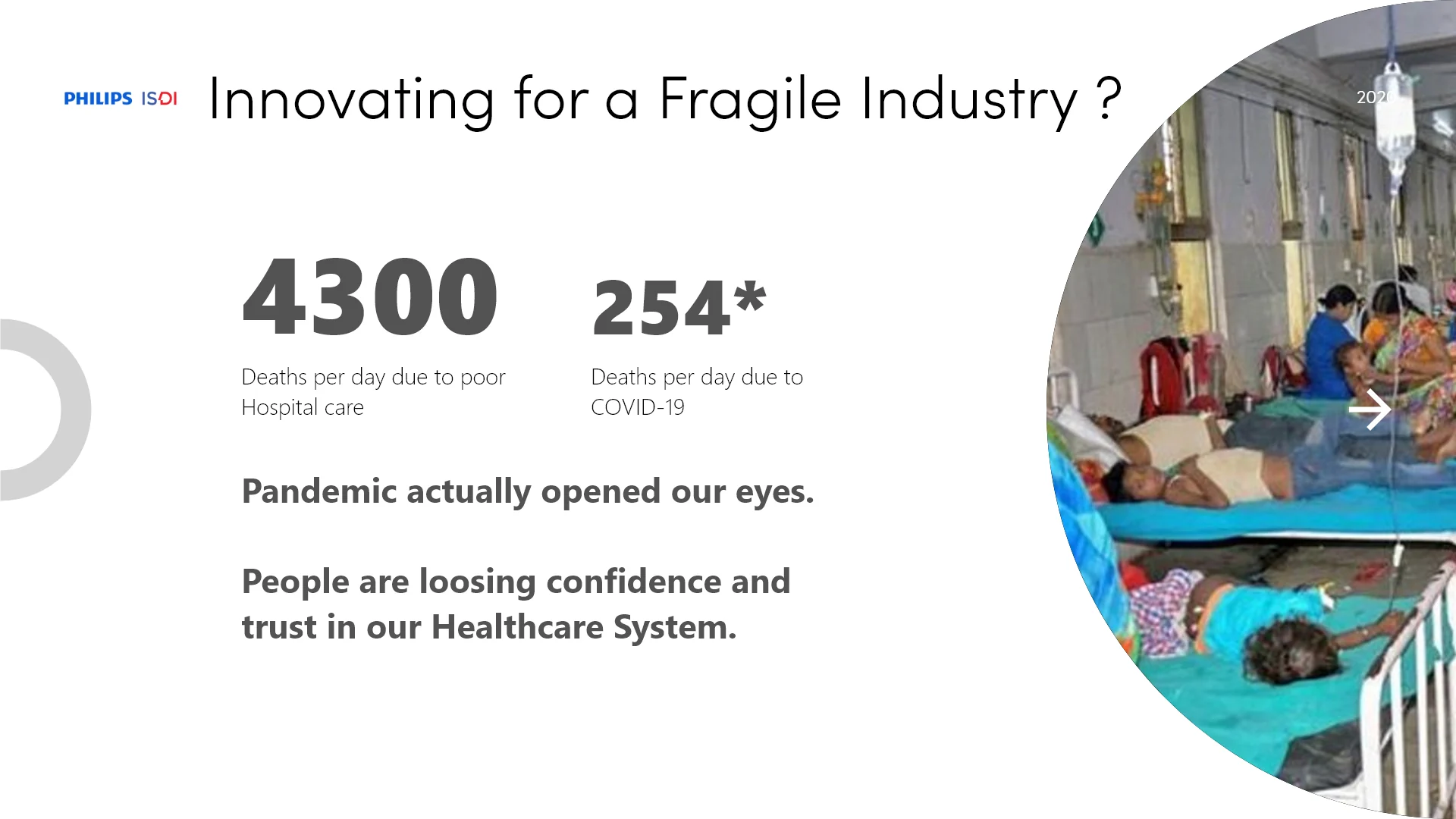
The original project began by examining the fragility of healthcare delivery under pressure. Its 2020 research deck cited approximately 4,300 deaths per day in India due to poor-quality care. That rounded figure is consistent with the 1,599,870 annual estimate derived from 2016 data in Kruk et al.'s health-system mortality analysis and the corresponding NHSRC country table.
The same slide recorded 254 COVID-19 deaths per day as a point-in-time 2020 figure. Its date and original reference are not recoverable from the supplied deck, so it is retained here as a historical project-research snapshot rather than a current benchmark.
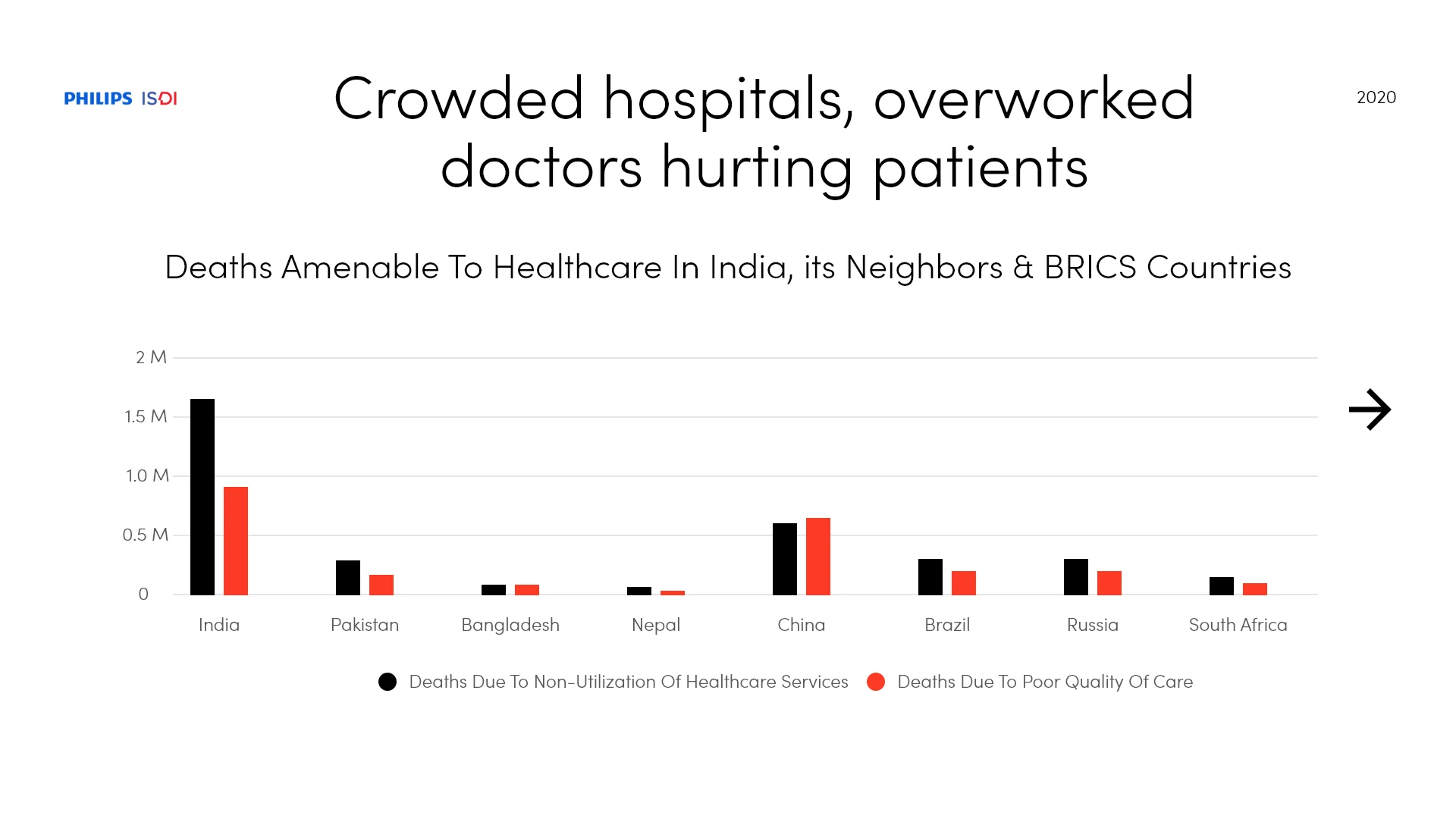
The research compared deaths considered amenable to healthcare across India, neighbouring countries, and selected BRICS countries, distinguishing non-utilisation of services from use of poor-quality services.
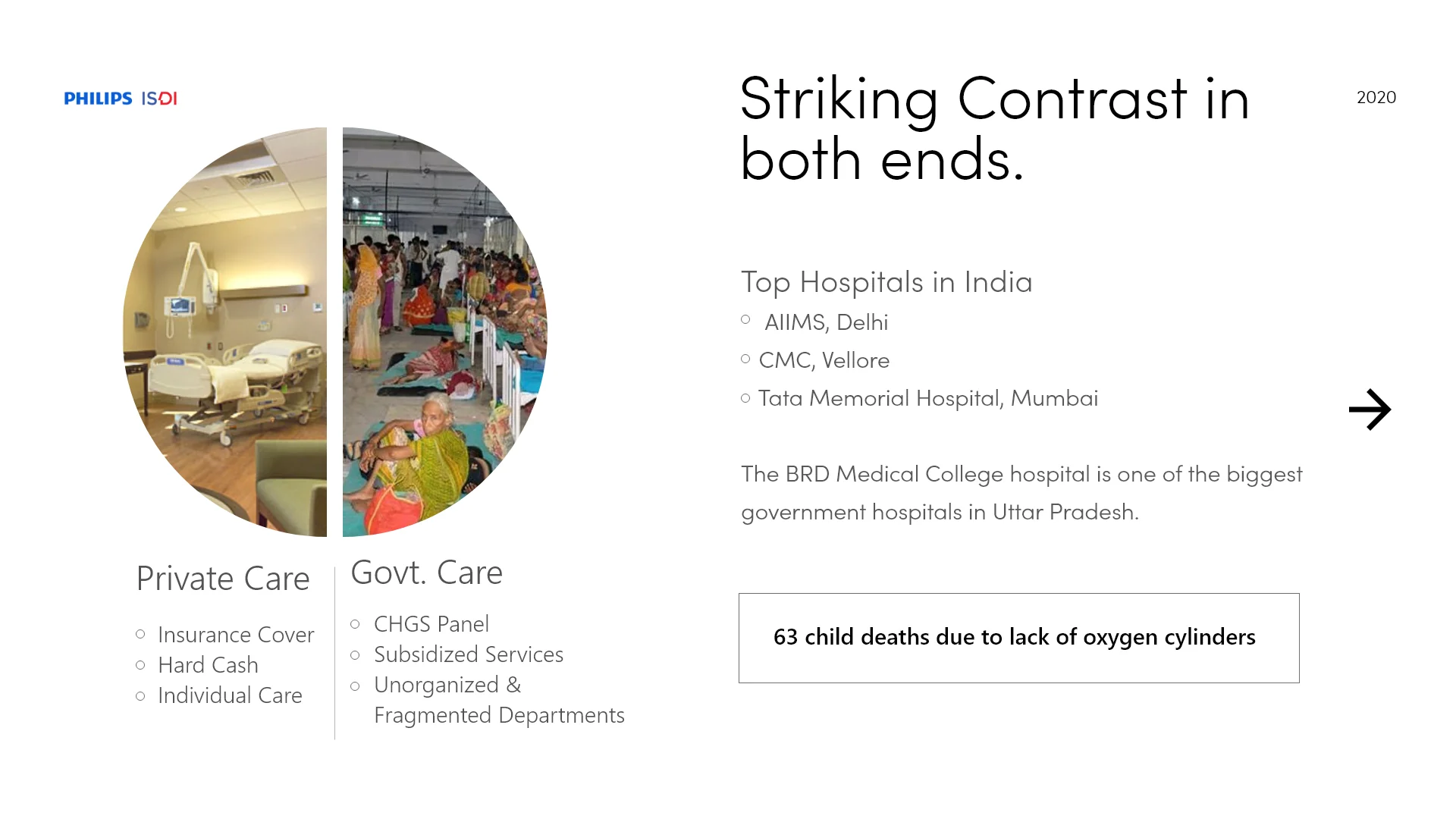
The deck also contrasted organised private care with constrained government-hospital environments. It referenced 63 child deaths at BRD Medical College as part of this framing. Because the official state account disputed that an oxygen shortage caused the deaths, the incident is treated here as a contested historical reference rather than a settled causal claim. See the contemporaneous official report carried by DD News.
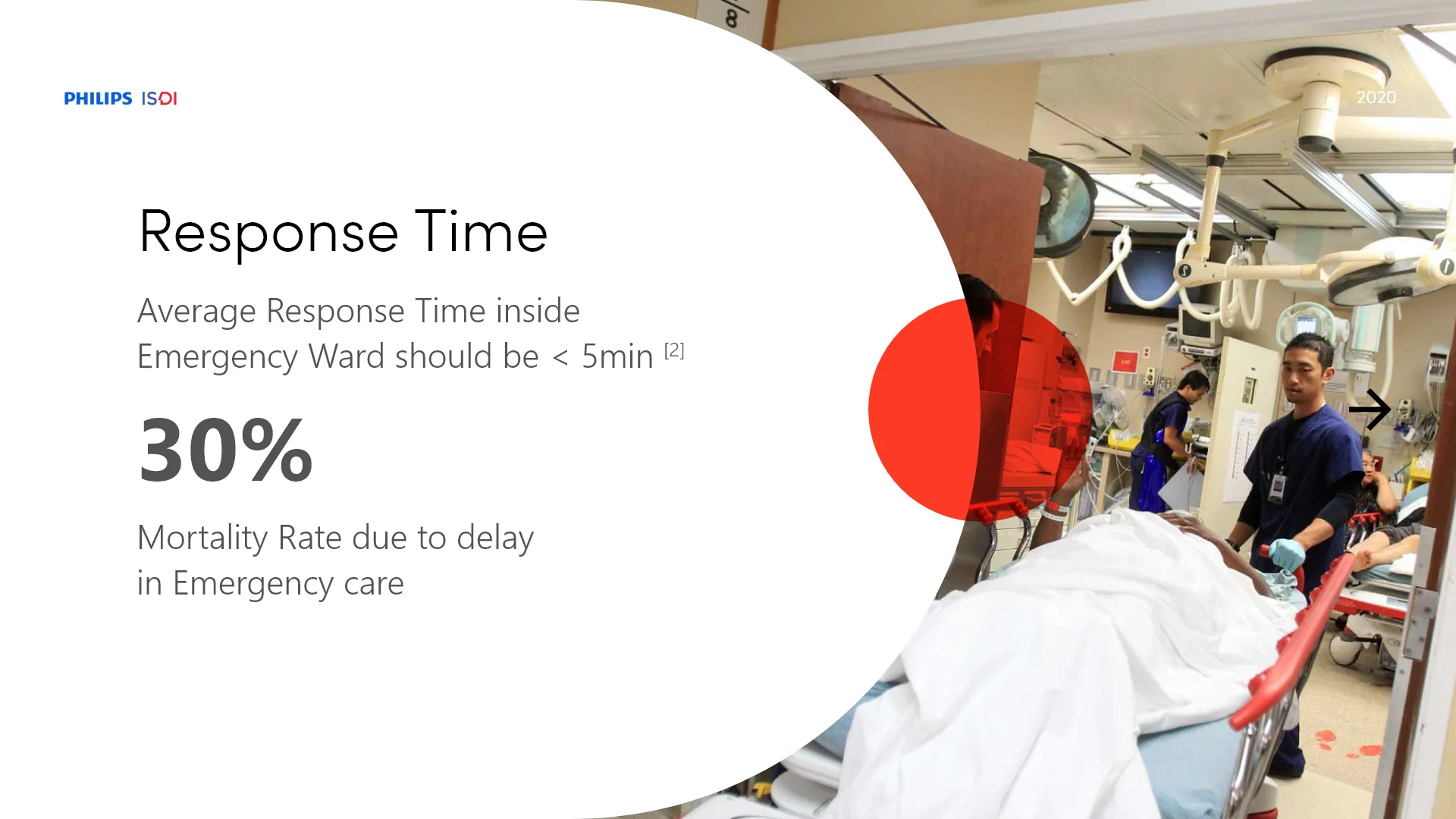
The project treated response time as a design concern. Its deck used an under-five-minute emergency-ward target whose original reference could not be recovered, alongside a 30% mortality figure attributed to delayed emergency care that is also reported in the NITI Aayog-AIIMS national assessment. The five-minute value is therefore presented as the project's research target, not as a universal clinical standard.
As an Industrial Design Intern, I led the project across:
The project was mentored by Mr. Sundarjeeth Jadhav.
The documented sequence moved through five connected phases:
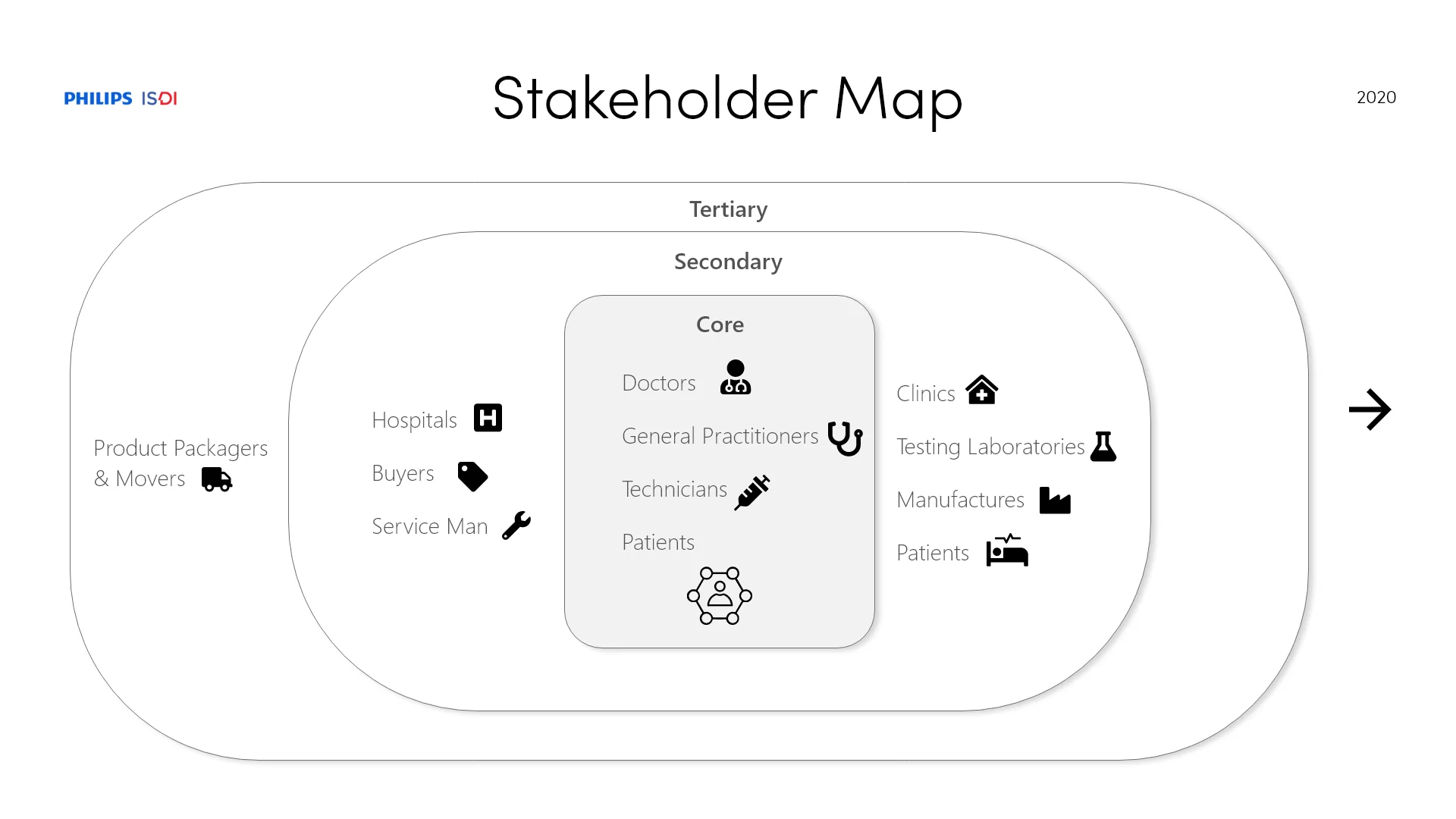
The project considered doctors, general practitioners, technicians, service personnel, patients, hospitals, clinics, laboratories, manufacturers, buyers, and product movers. Rather than treating the cart as an isolated object, the research framed it as one participant in a larger emergency-care system.
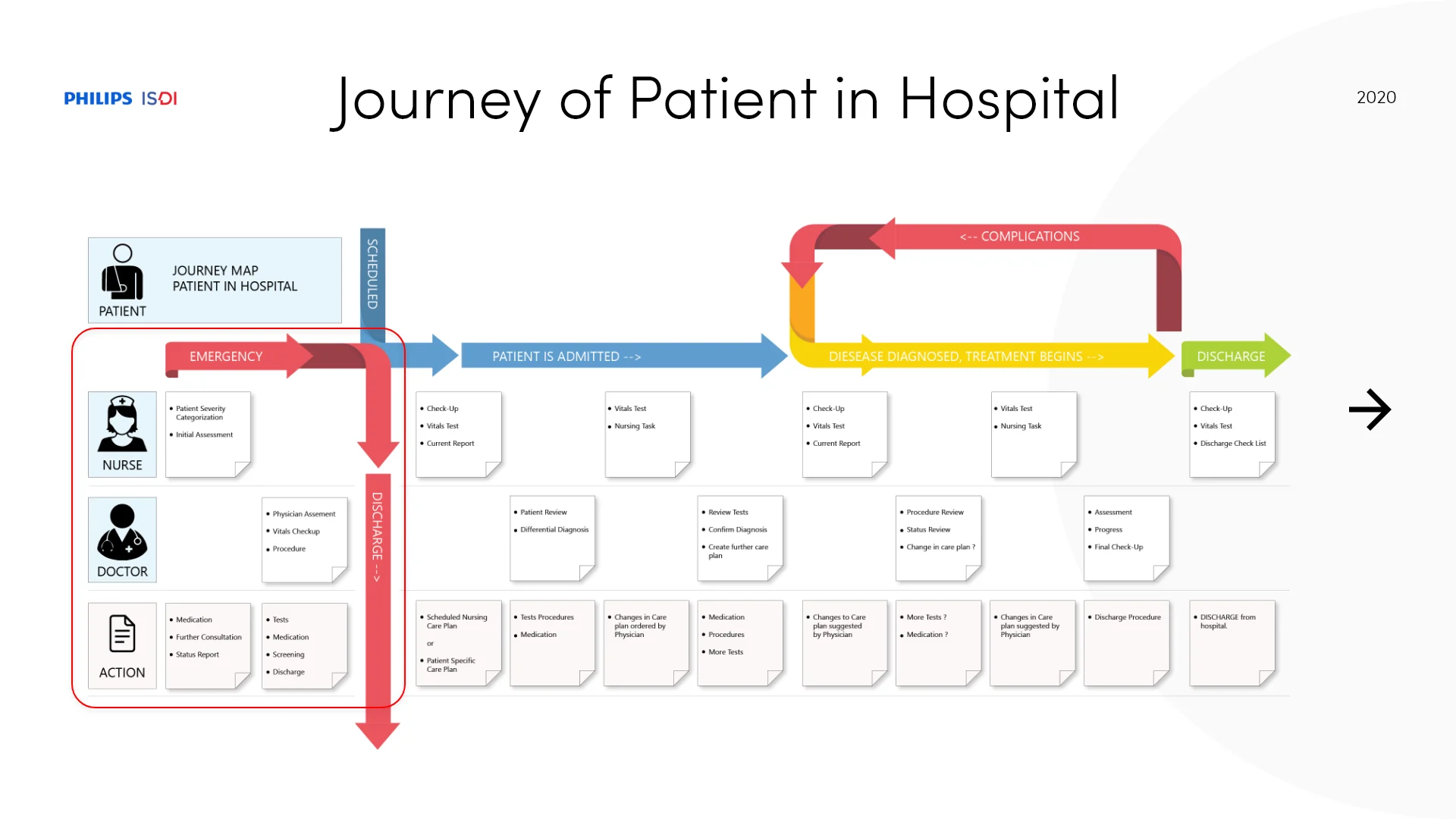
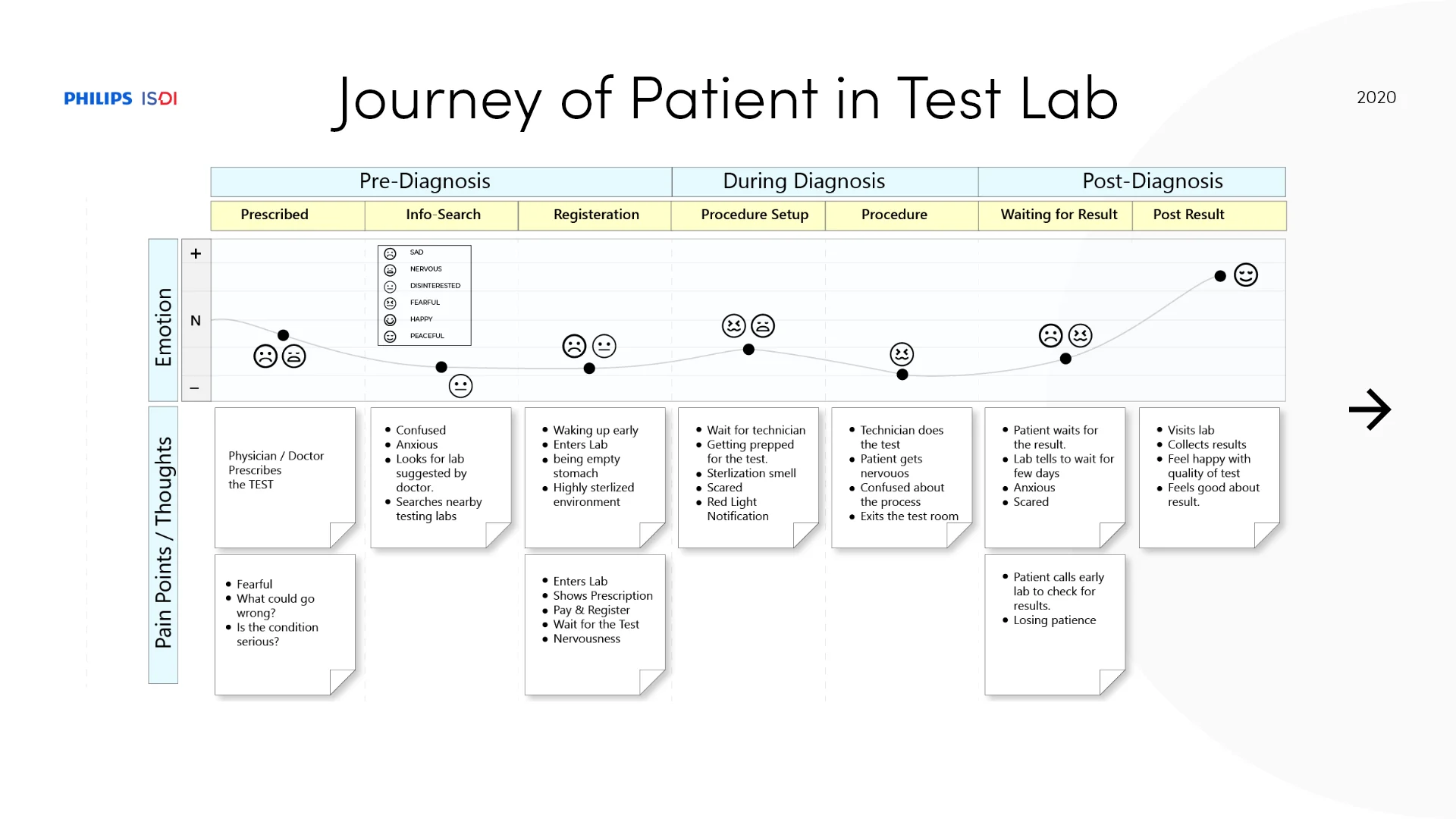
The hospital journey mapped activity across emergency arrival, admission, diagnosis, treatment, complications, discharge, and follow-up. A second journey focused on the test-lab experience, including unclear processes, waiting, anxiety, and the delay between testing and results.
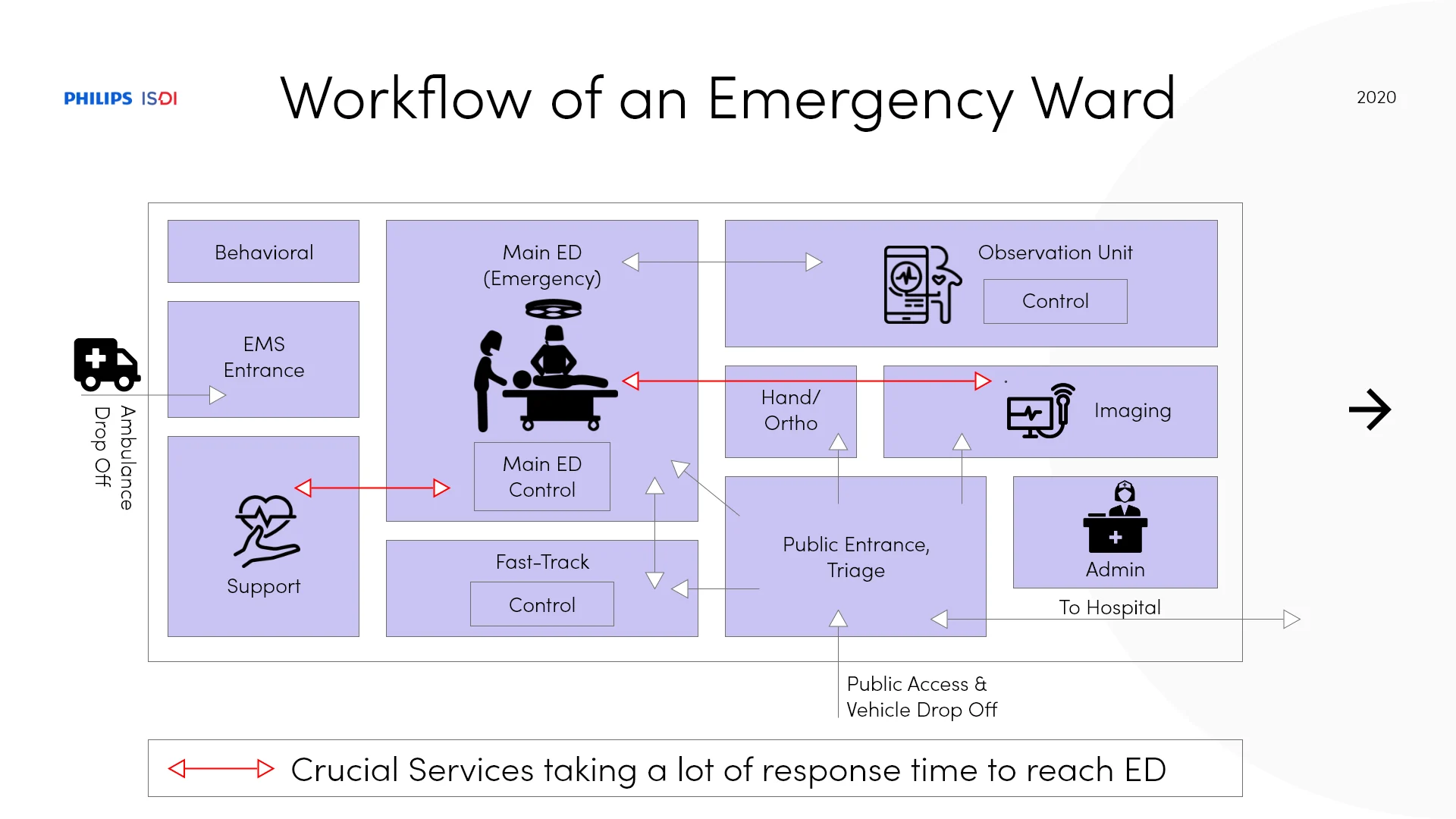
The emergency-ward map connected ambulance and EMS arrival with the main emergency department, fast track, triage, imaging, observation, administration, and support functions. It highlighted the distance between the emergency department and services that could be needed quickly.
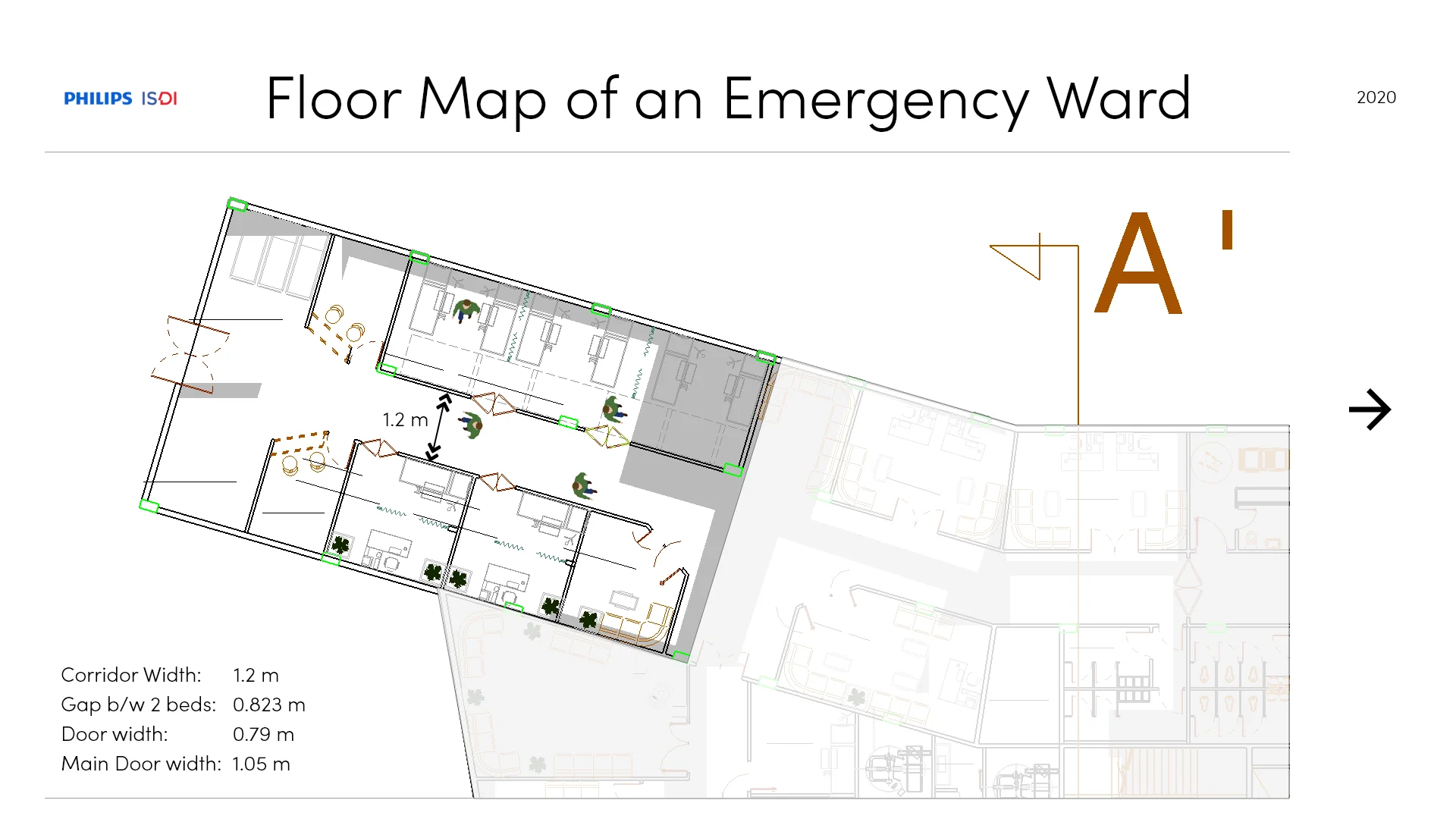
The floor-plan study recorded a 1.2 m corridor, a 0.823 m gap between beds, a 0.79 m door, and a 1.05 m main doorway in the studied plan. These project measurements established a tight operating envelope for movement, turning, access, and storage.
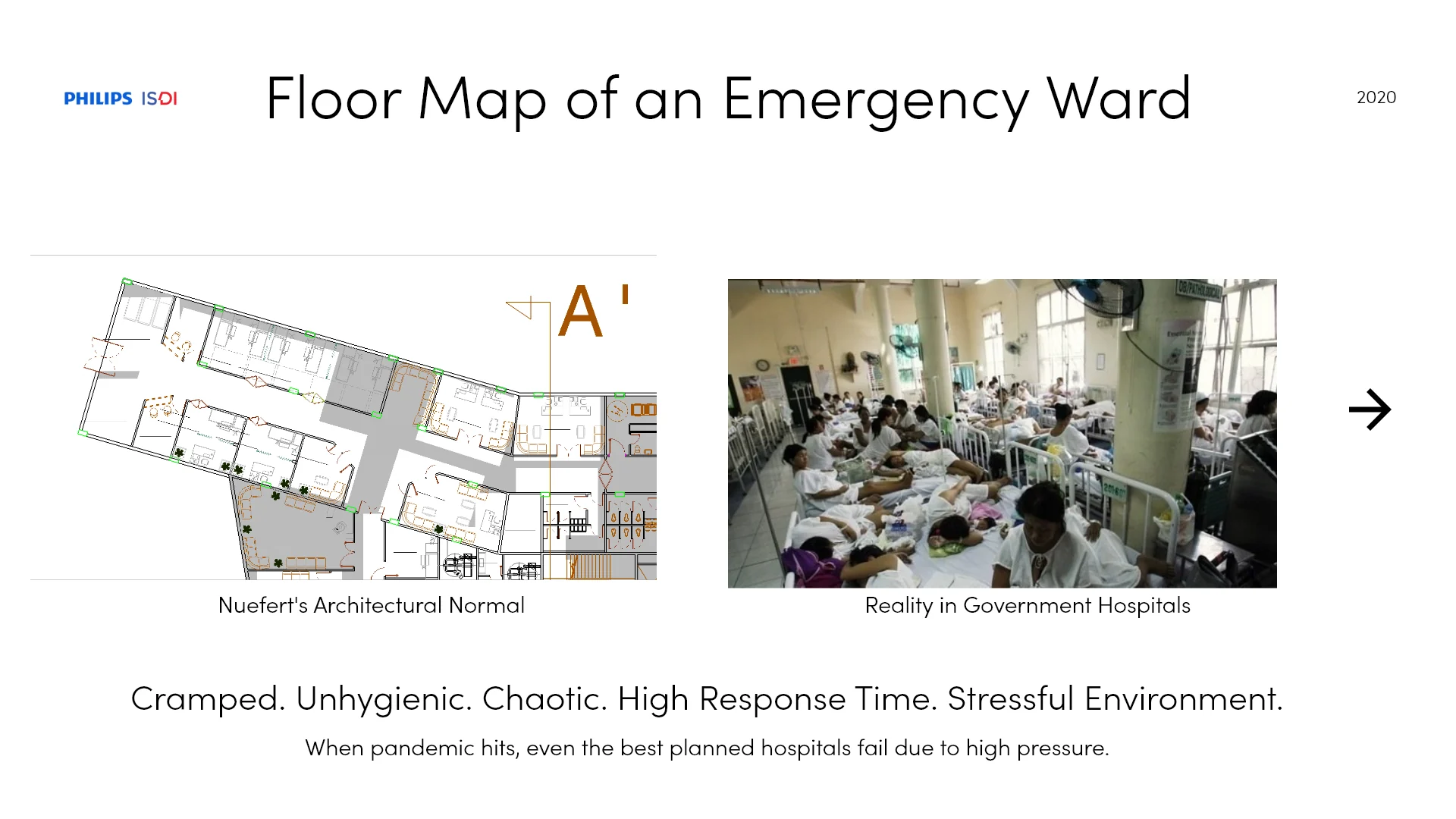
The next comparison placed architectural planning guidance beside the crowded conditions represented in the deck. It framed the environment as cramped, chaotic, stressful, and difficult to keep hygienic, particularly when demand rises.
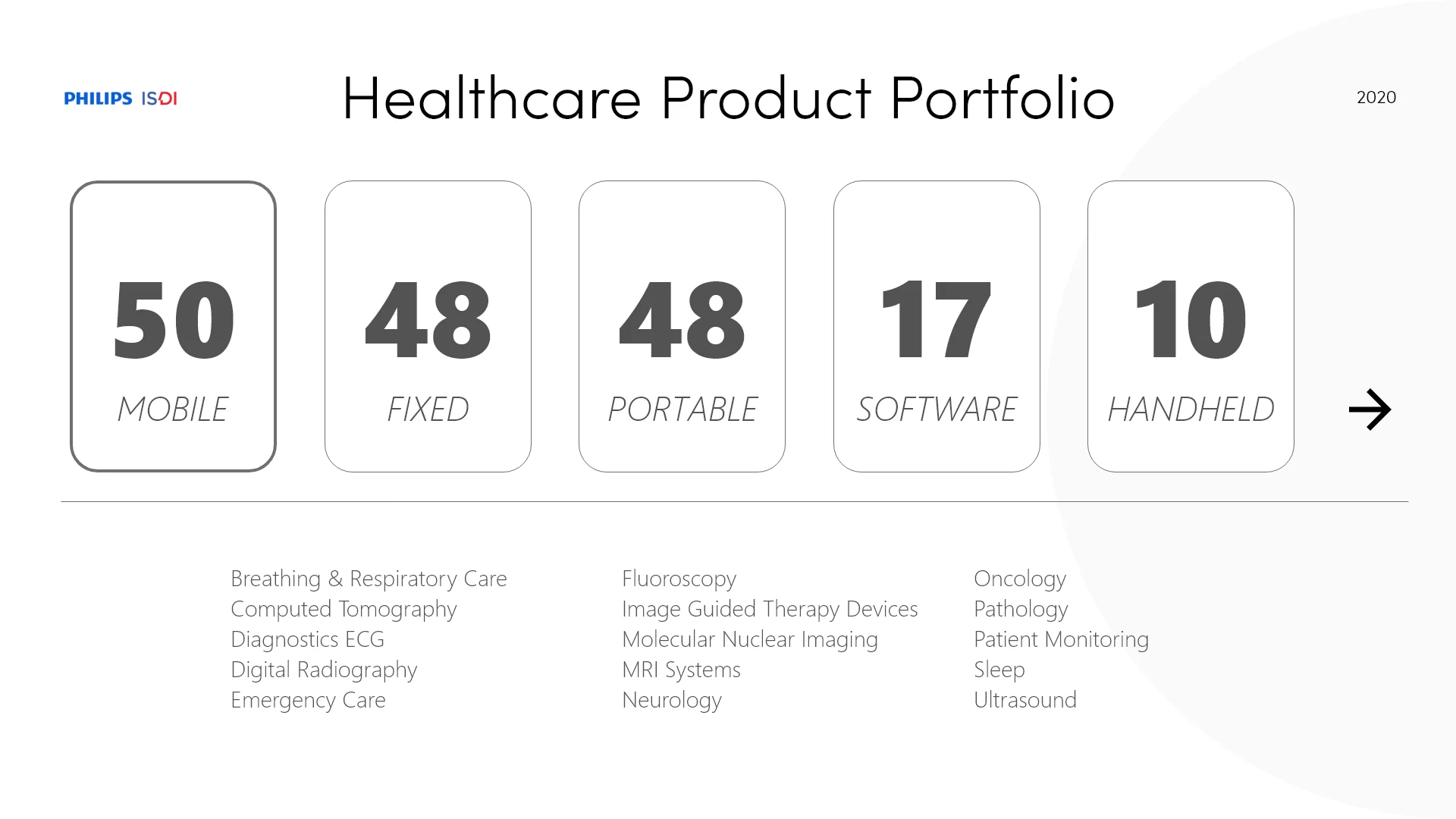
The project inventoried the healthcare portfolio across mobile, fixed, portable, software, and handheld products. The counts shown in the original deck were part of the 2020 project audit; its counting method and publication source were not documented.
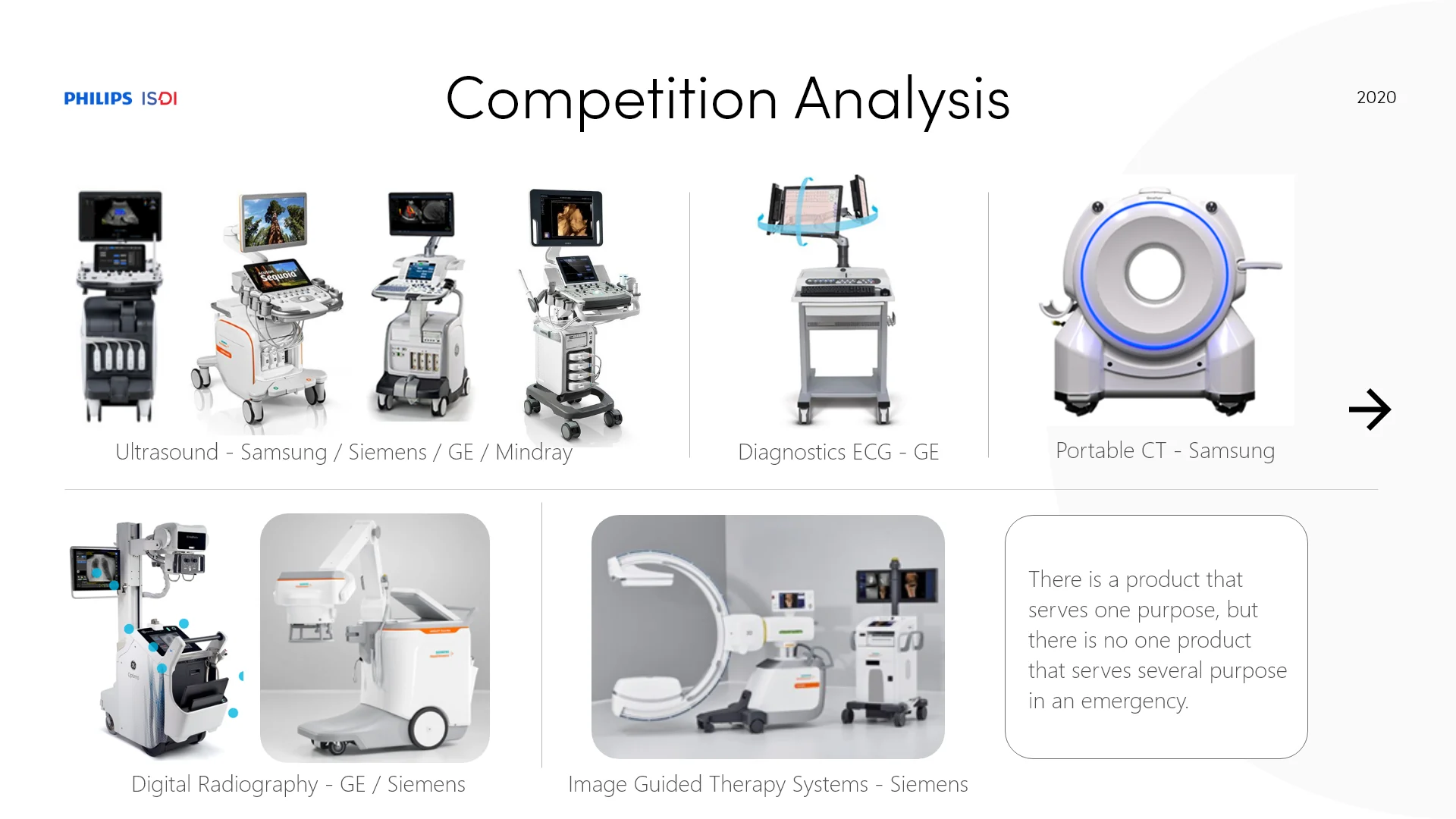
Competitive examples from Samsung, Siemens, GE, and Mindray were compared across ultrasound, diagnostic ECG, portable CT, radiography, and image-guided therapy. The analysis identified a design opportunity between monitoring, diagnosis, and emergency preparedness.
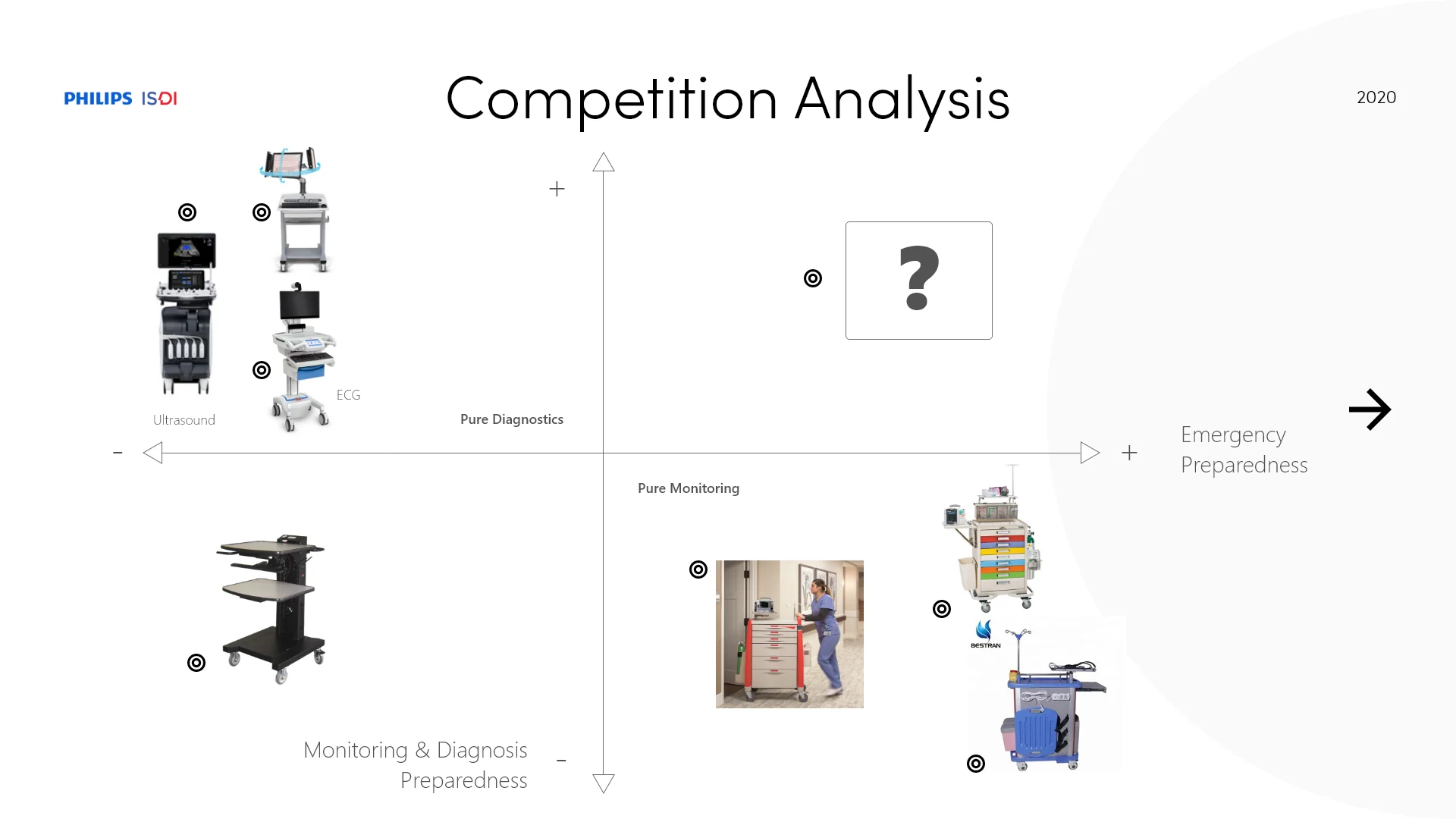
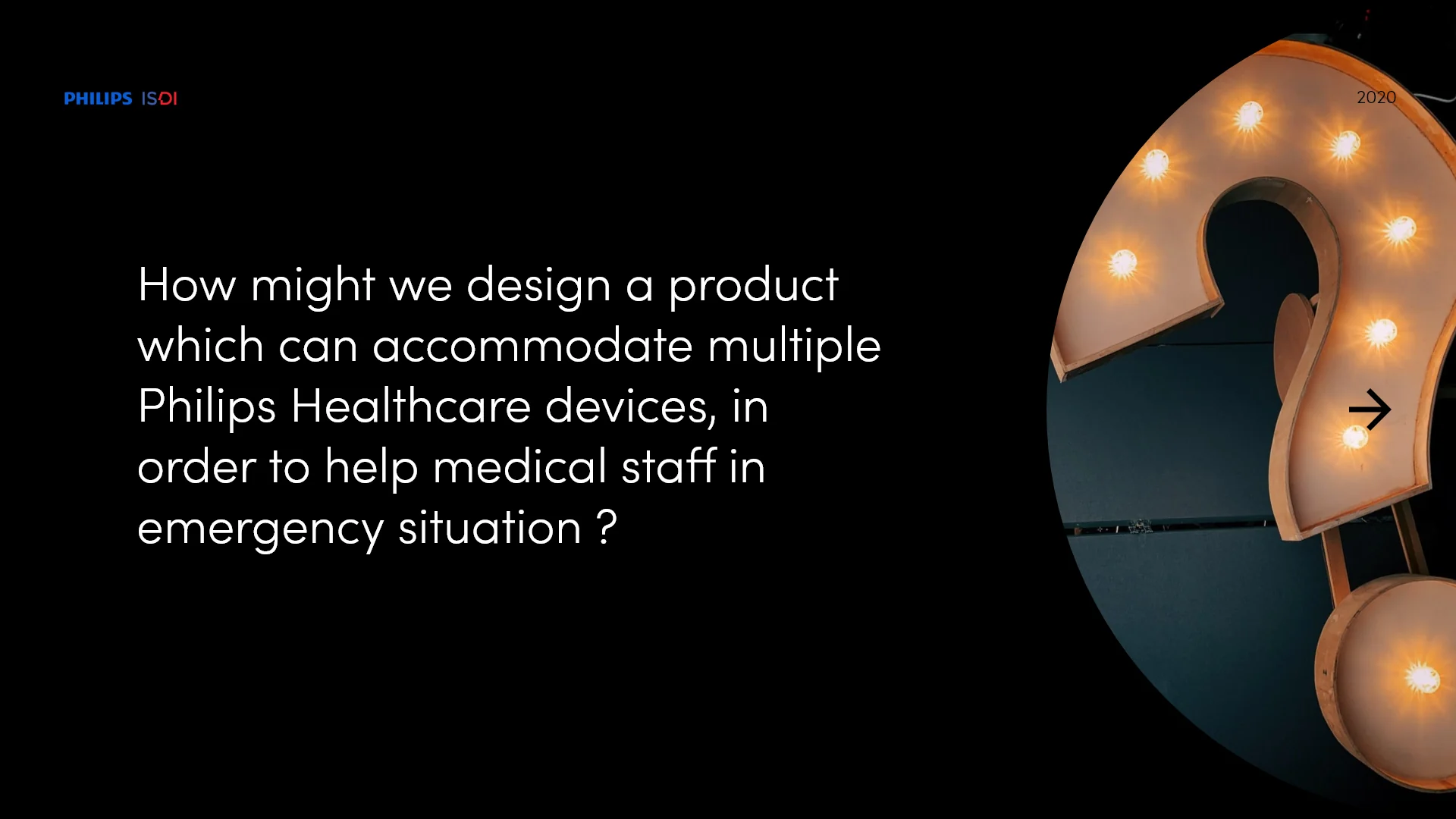
The project framed the opportunity as:
How might one mobile product accommodate multiple Philips healthcare devices and support medical staff during emergency situations?
The stakeholder map placed doctors, general practitioners, technicians, and patients close to the core experience, with institutions, manufacturers, buyers, service staff, laboratories, and logistics roles around them.
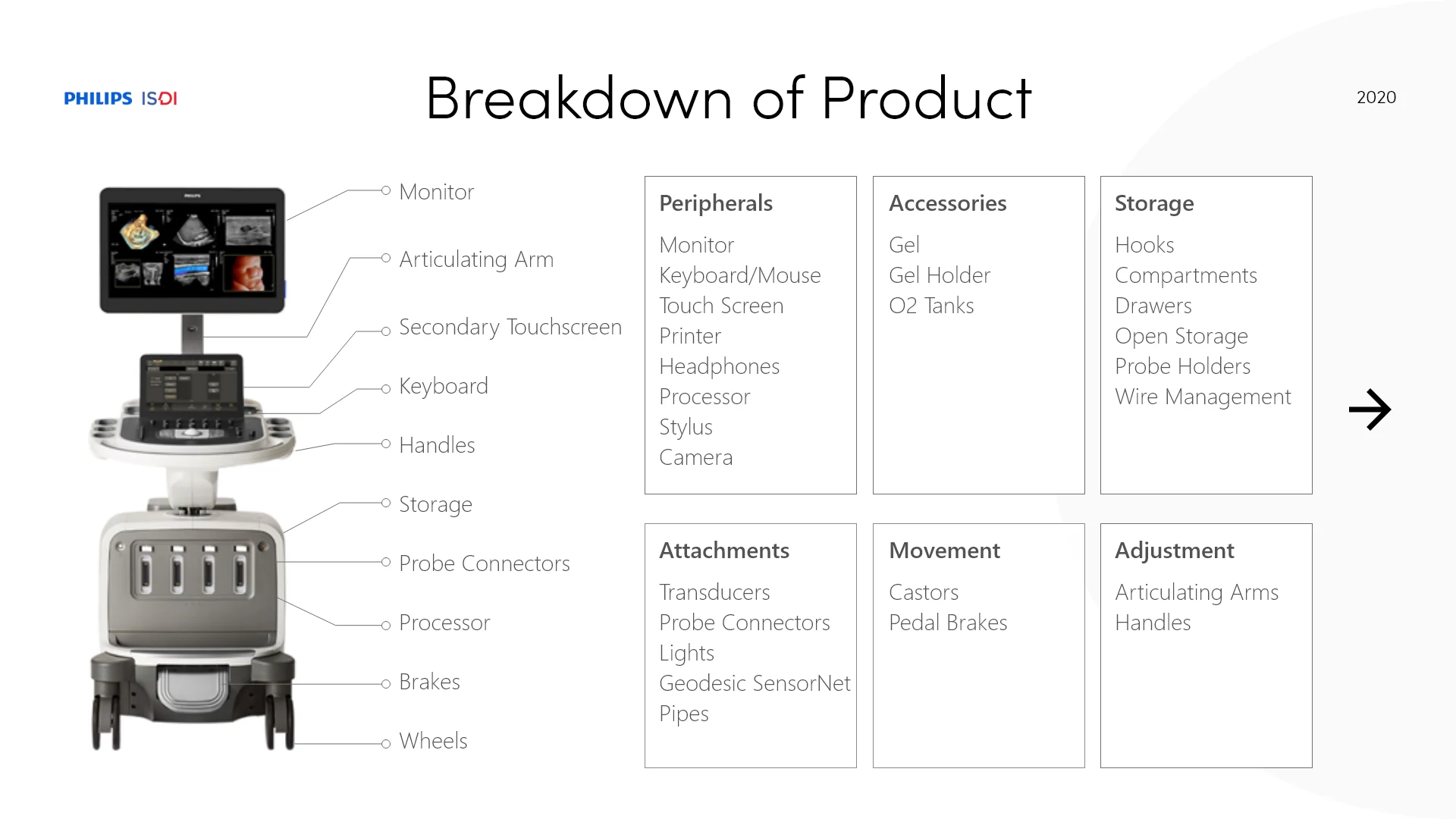
An existing cart was decomposed into peripherals, attachments, accessories, movement, storage, and adjustment. This created a working vocabulary for screens, controls, probes, tanks, drawers, handles, castors, brakes, articulation, and cable management.
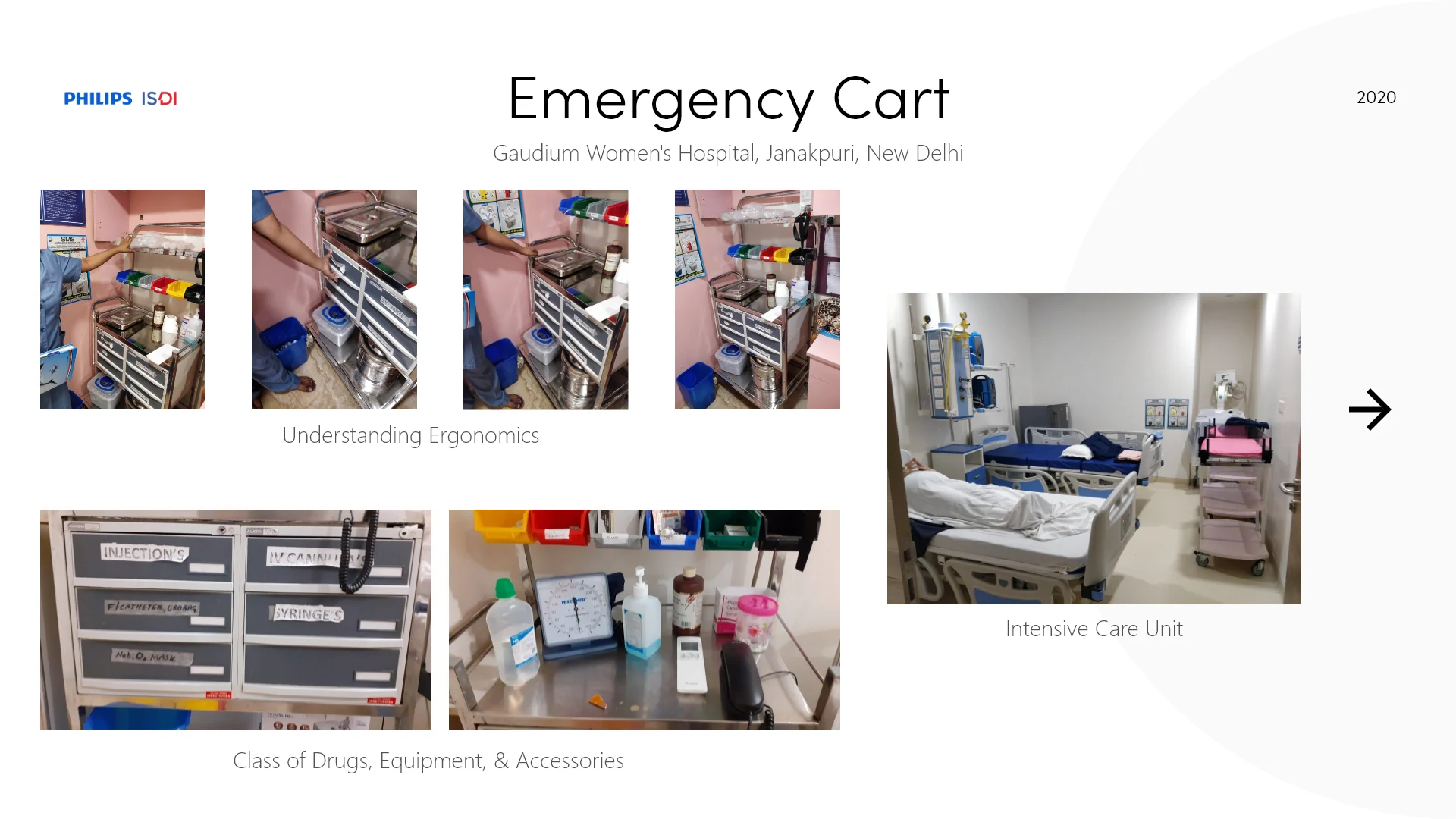
The source deck documents an emergency-cart observation at Gaudium Women's Hospital, Janakpuri, New Delhi. The study focused on ergonomics, the organisation of drugs and equipment, and the intensive-care context.
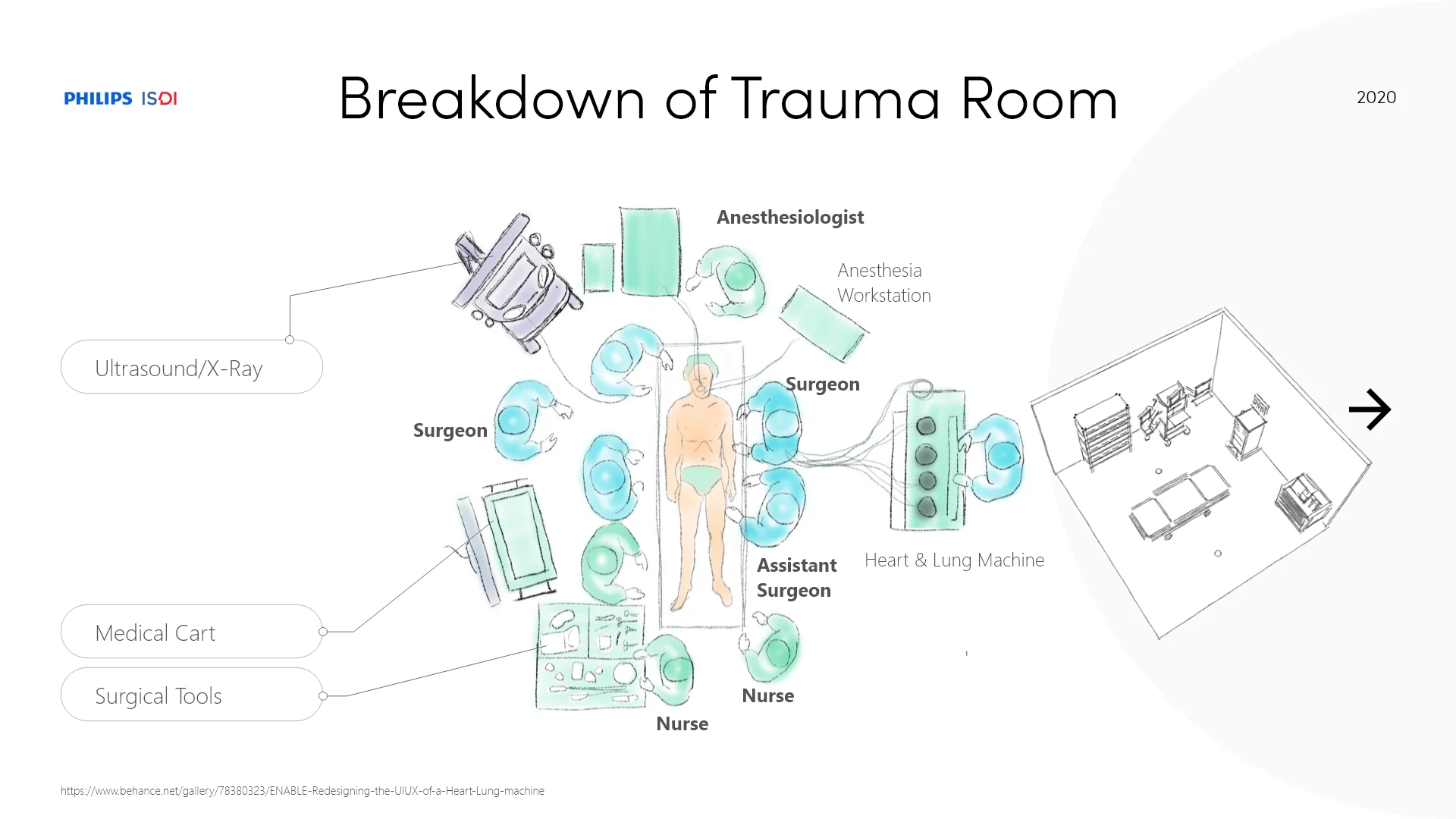
The trauma-room breakdown mapped staff positions alongside the anaesthesia workstation, ultrasound or X-ray equipment, heart-lung machine, medical cart, surgical tools, and other equipment.
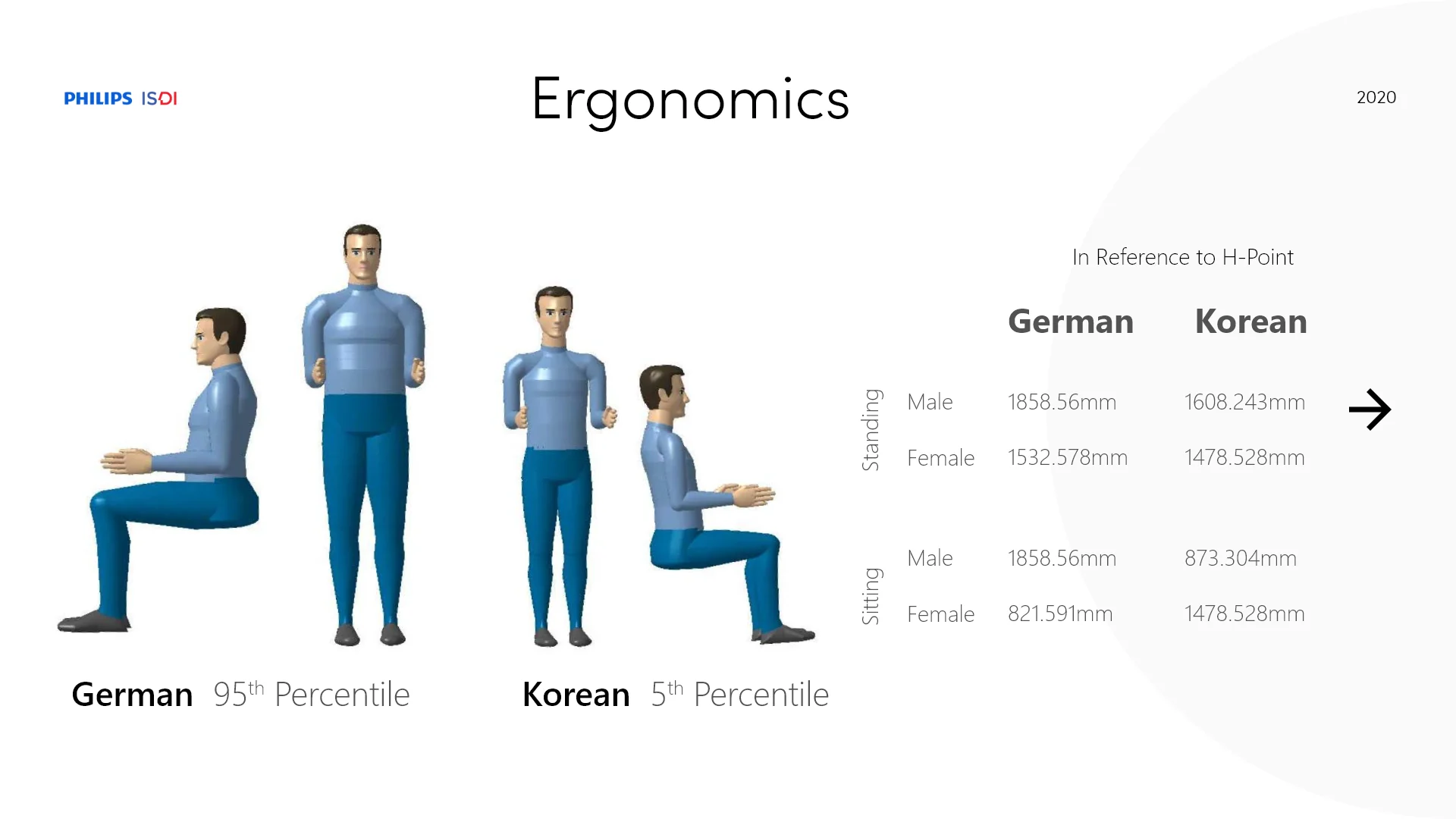
The ergonomics study used standing and seated body references to consider working height and reach. Several printed anthropometric values in the original slide appear duplicated or inconsistent, so they are retained visually but are not repeated here as verified dimensions.
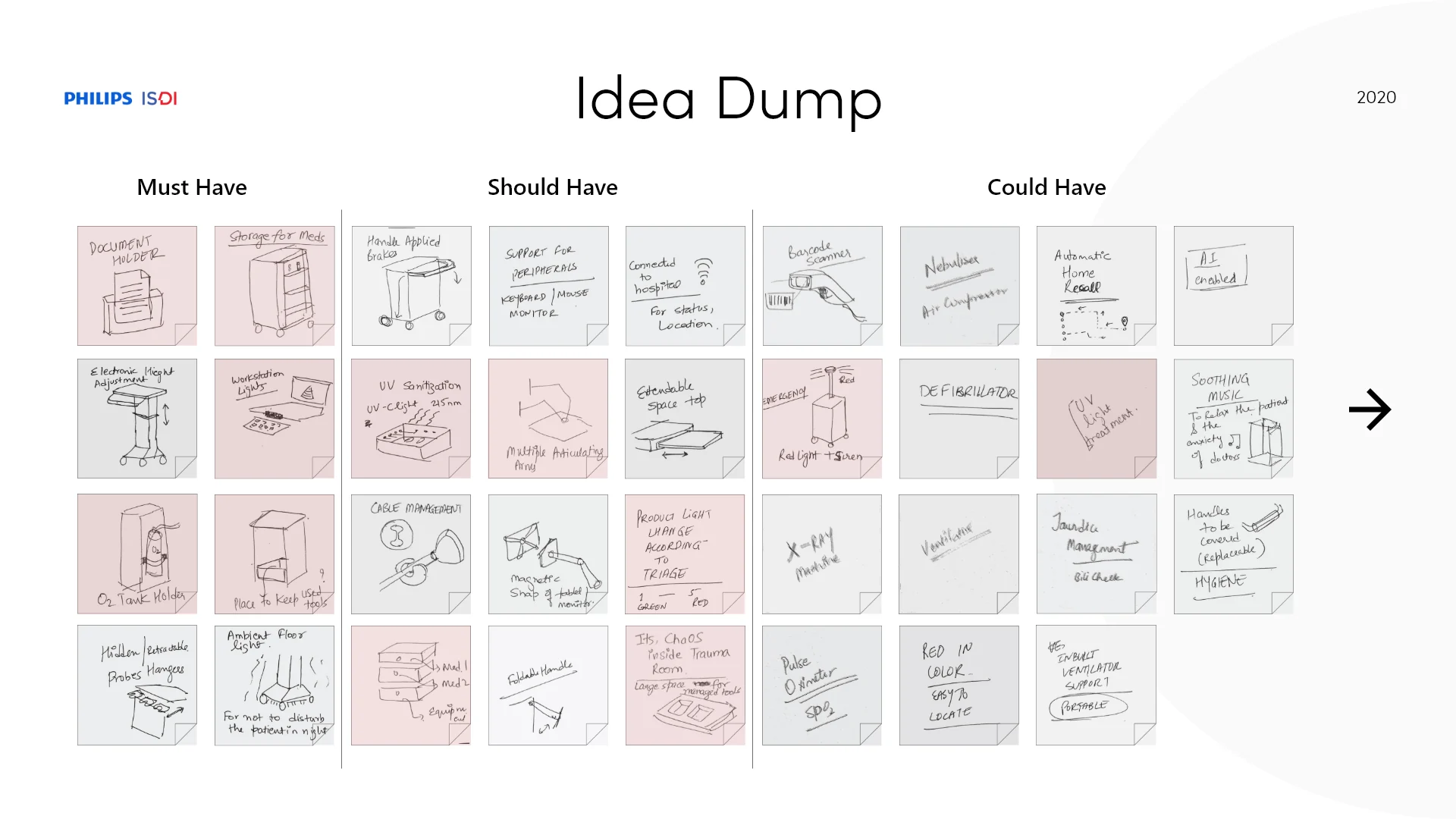
The idea dump grouped possibilities as must have, should have, and could have. Legible themes included:
Several handwritten cards are partly illegible; they are not presented as confirmed requirements.
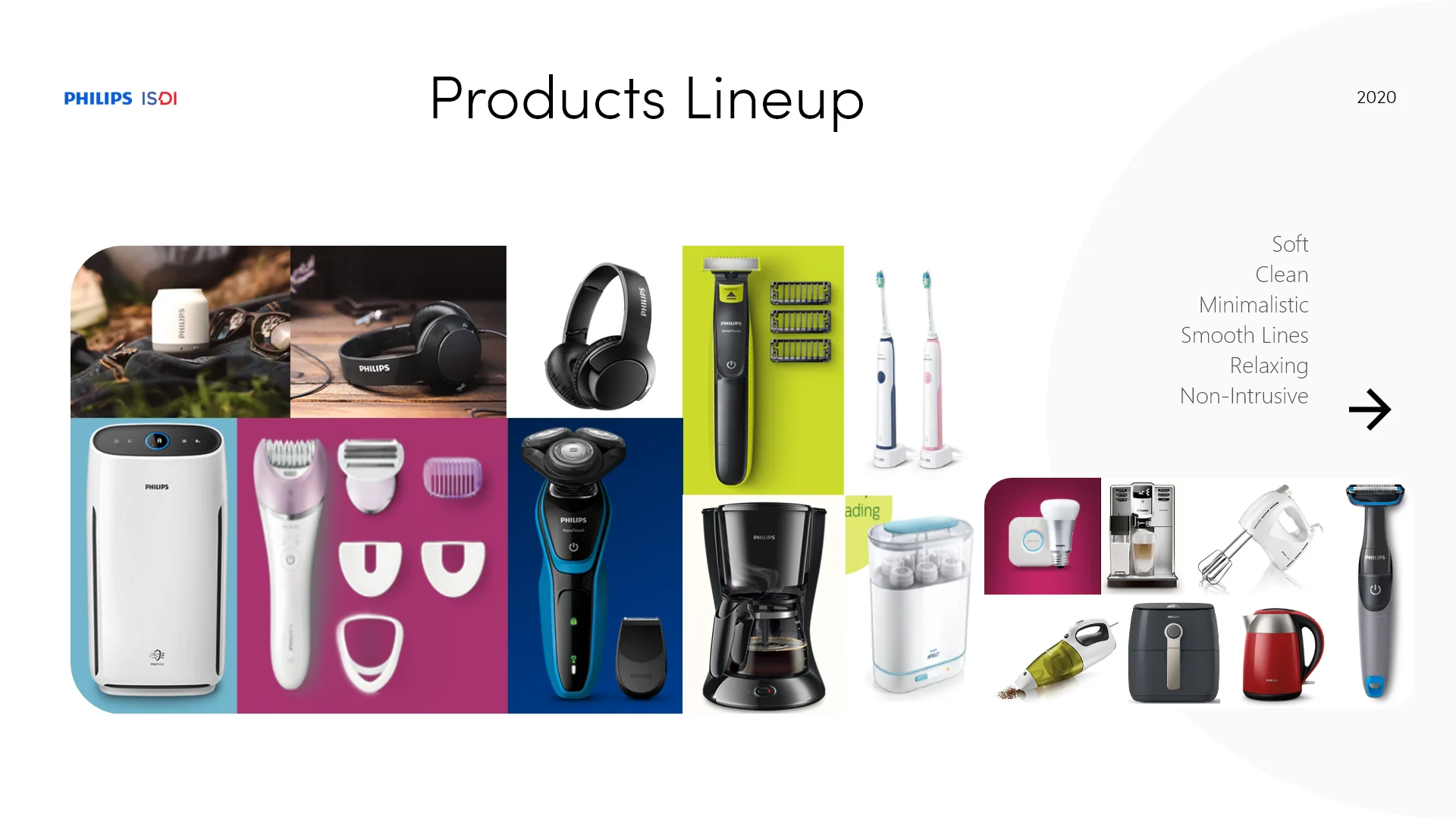
The visual-language study described Philips products as soft, clean, minimal, smooth, relaxing, and non-intrusive.
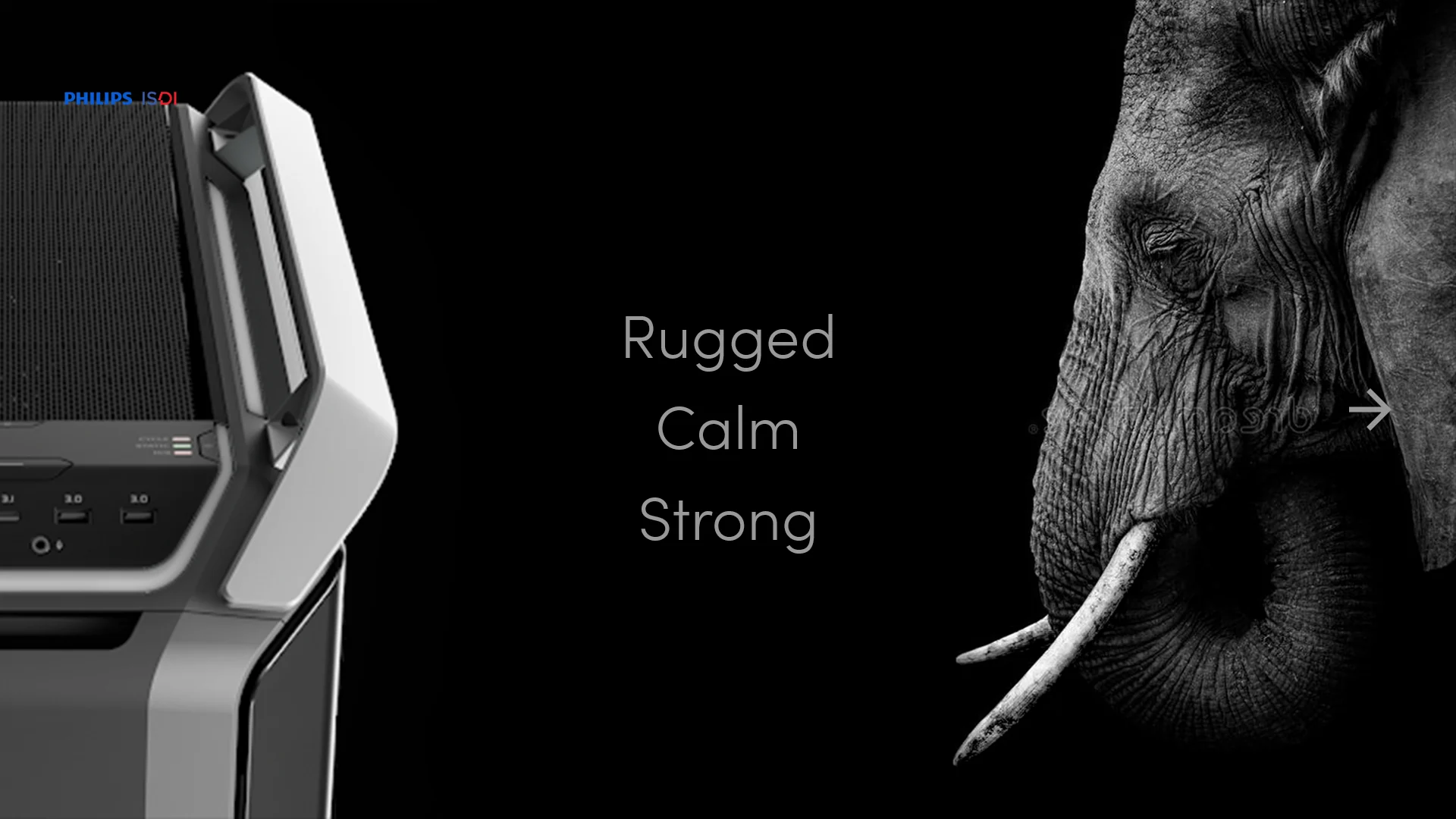
The mood board added three complementary qualities: rugged, calm, and strong. The intent was to balance the reassurance of clinical equipment with the physical confidence expected from a mobile emergency product.
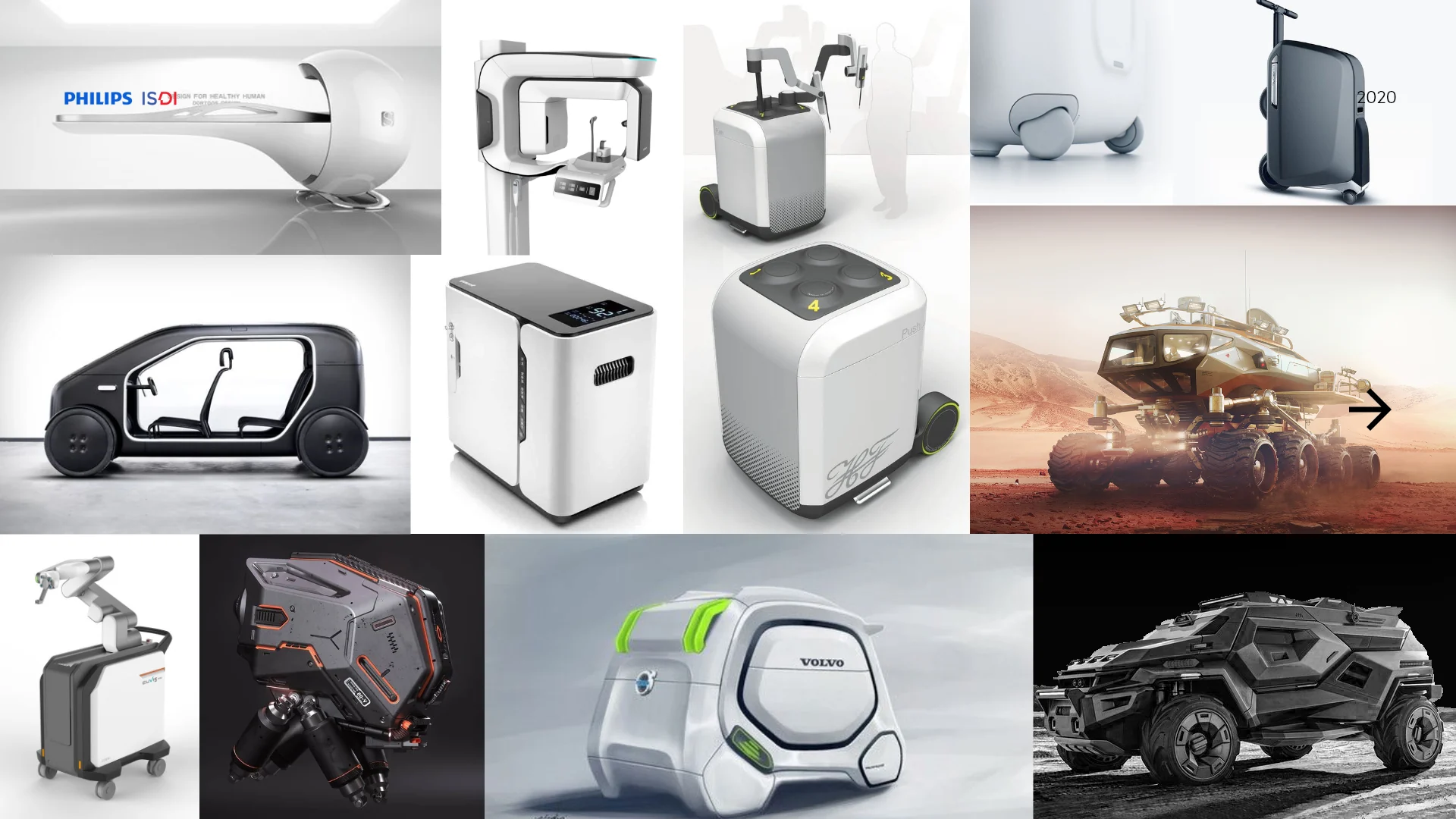
An inspiration board brought together compact medical equipment, protected edges, accessible modules, and rugged mobility references.
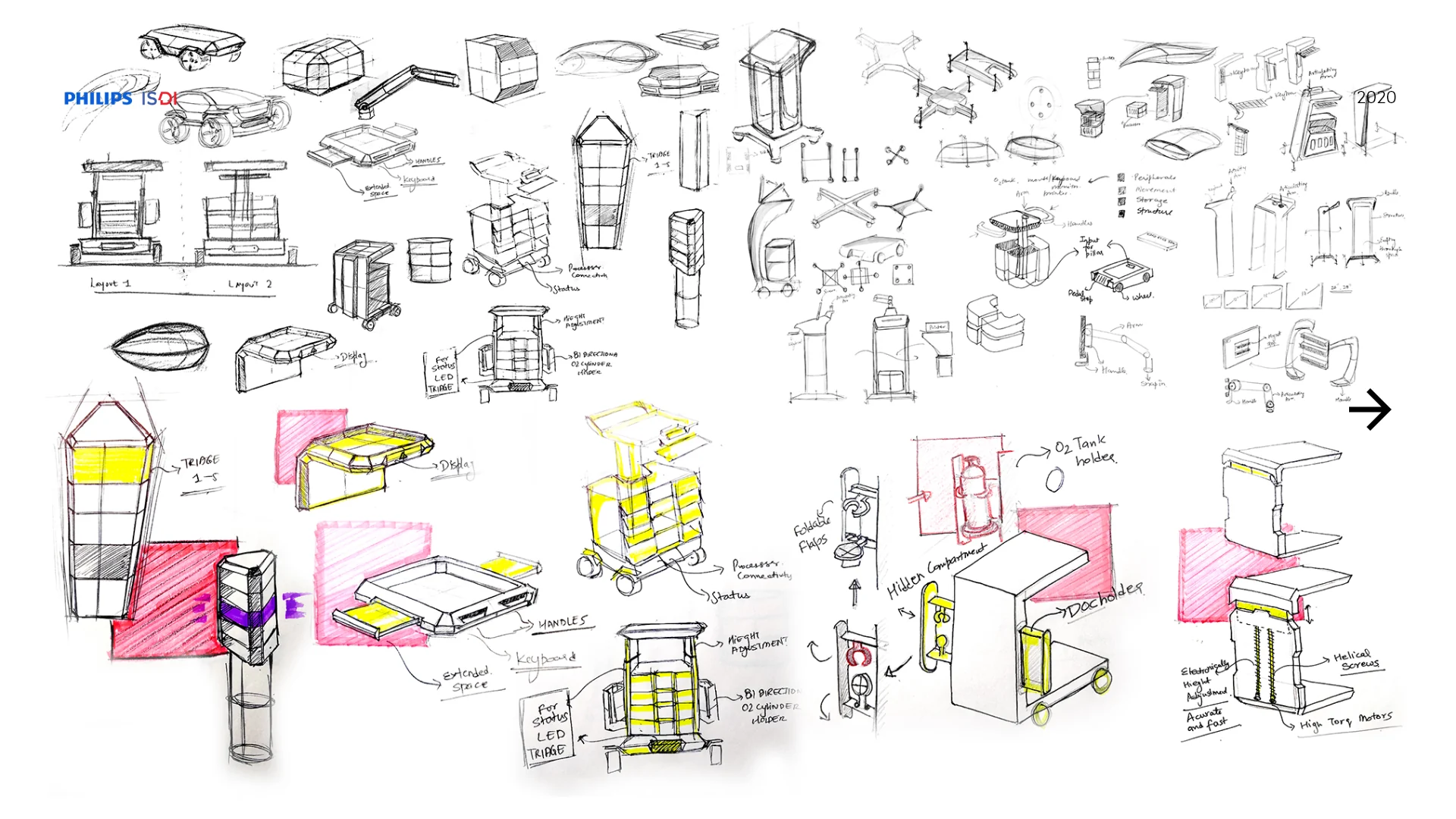
The sketch phase explored cart proportions, drawer and compartment layouts, screen supports, handles, oxygen-cylinder placement, wheel configurations, and modular attachments.
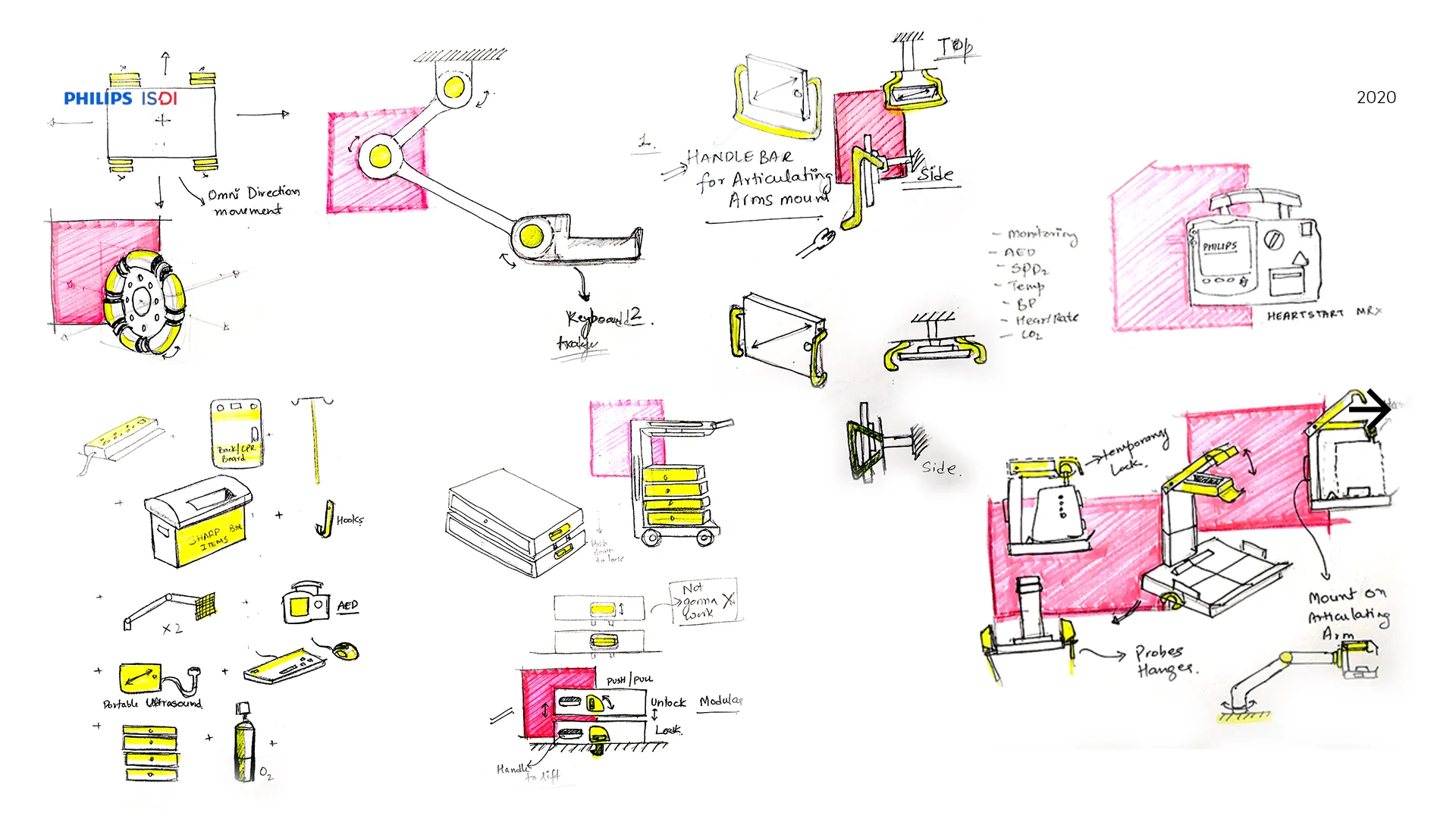
Two concept families were then developed. The source deck does not document a formal scoring model, stakeholder vote, or selection rationale, so both are shown as explored directions rather than as winners and losers.
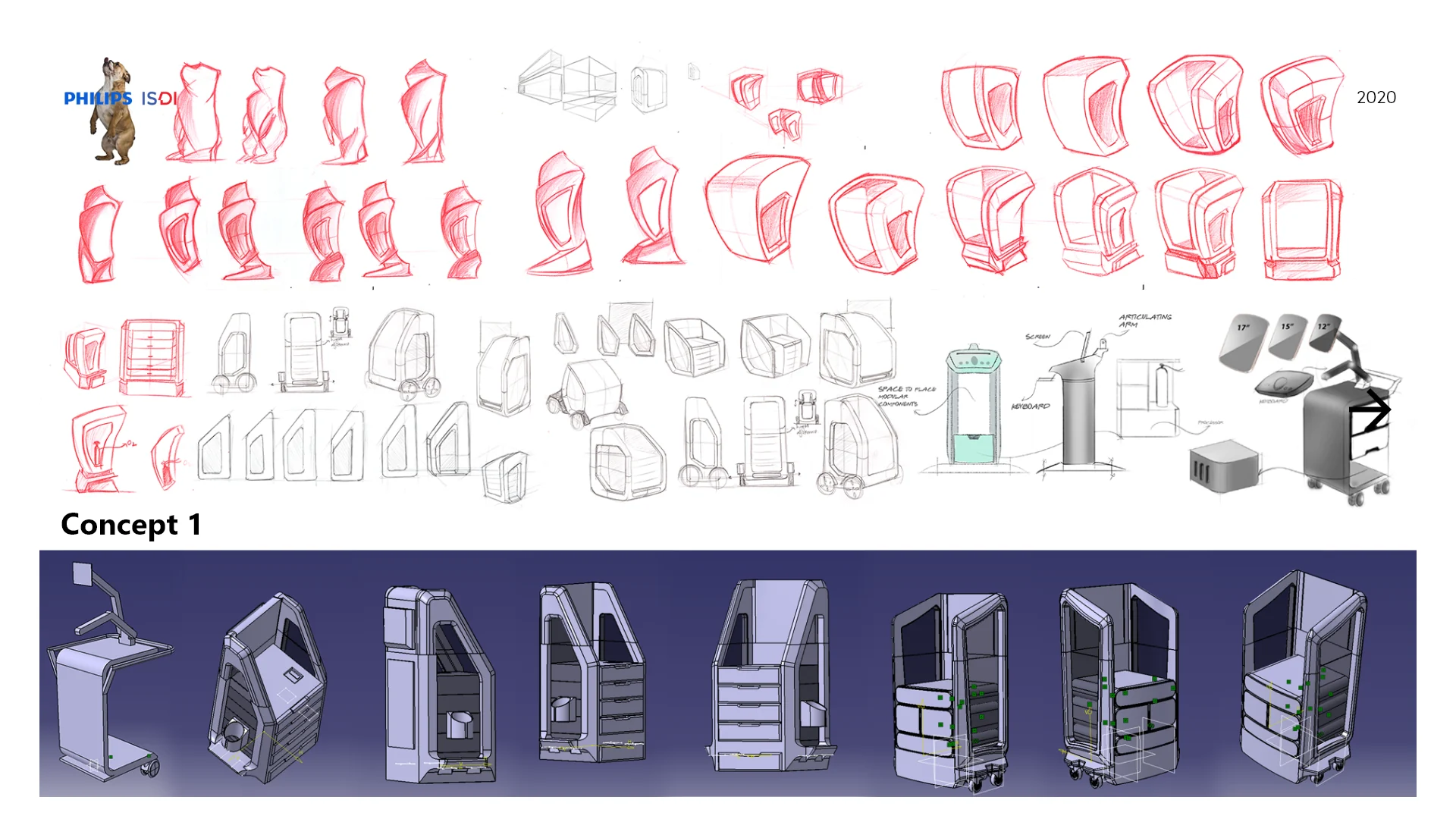
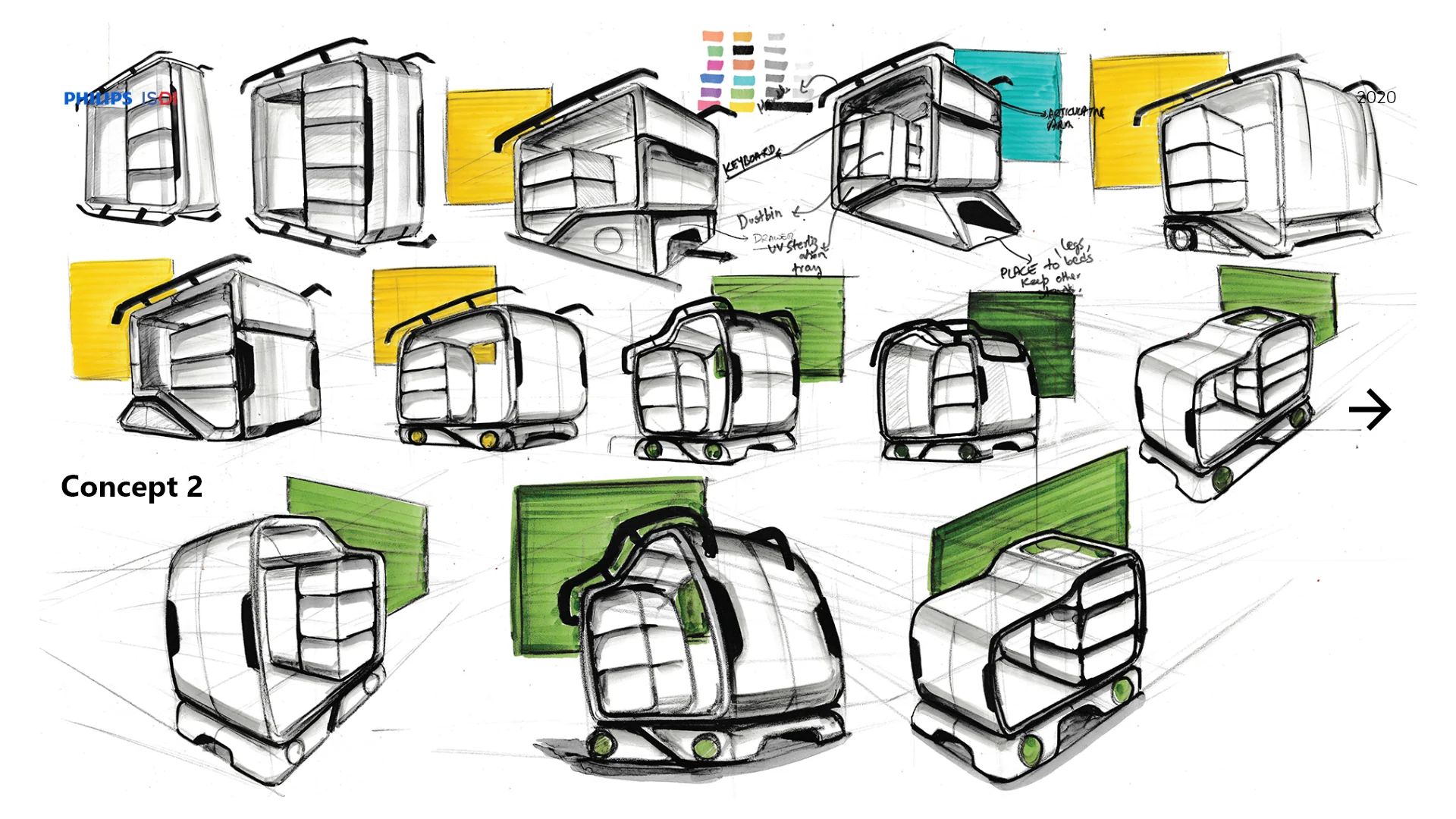
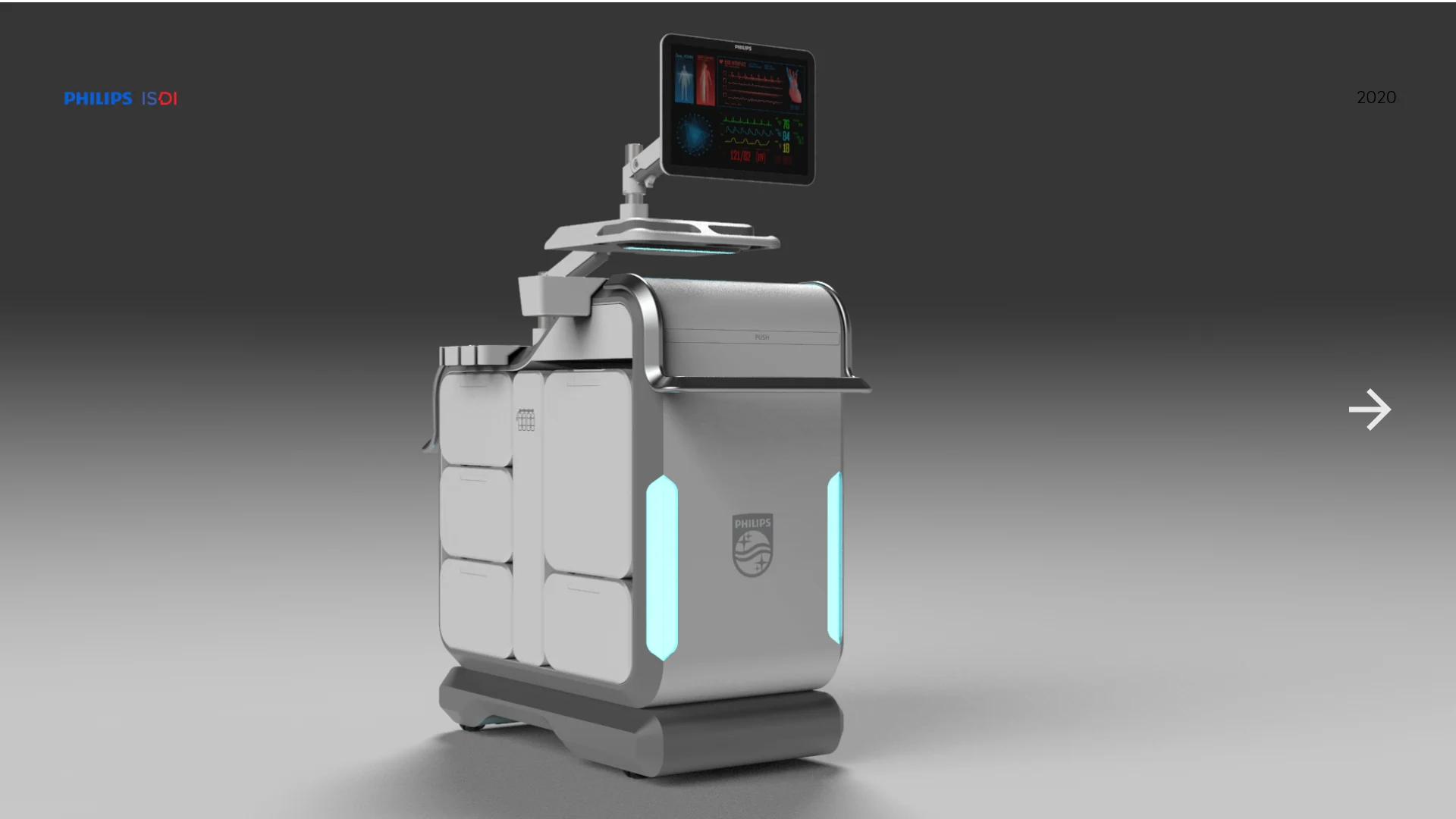
The direction taken forward was developed as Philips Life Shield: a mobile proposal intended to bring multiple diagnostic and emergency-support functions into one configurable platform.
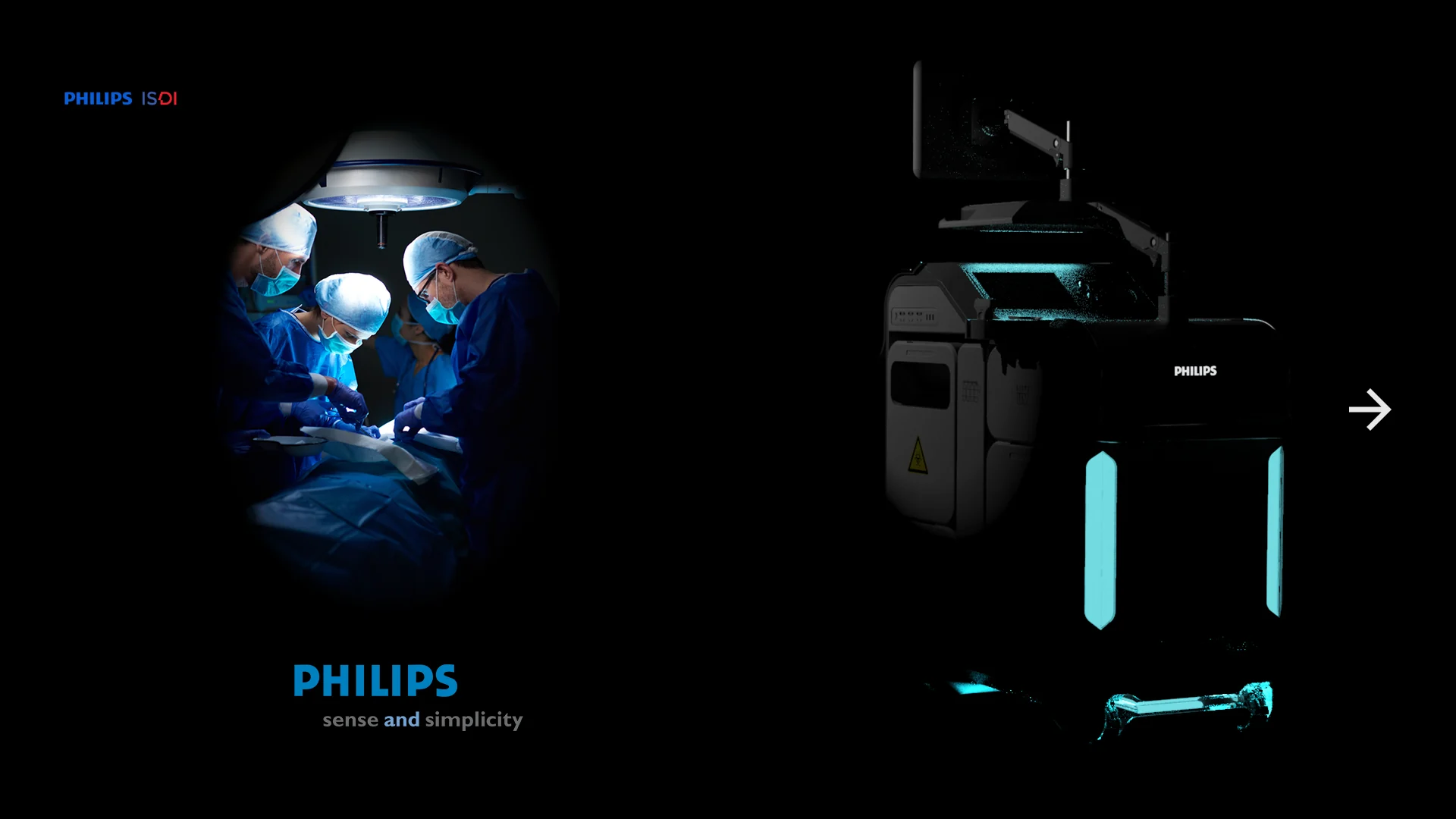
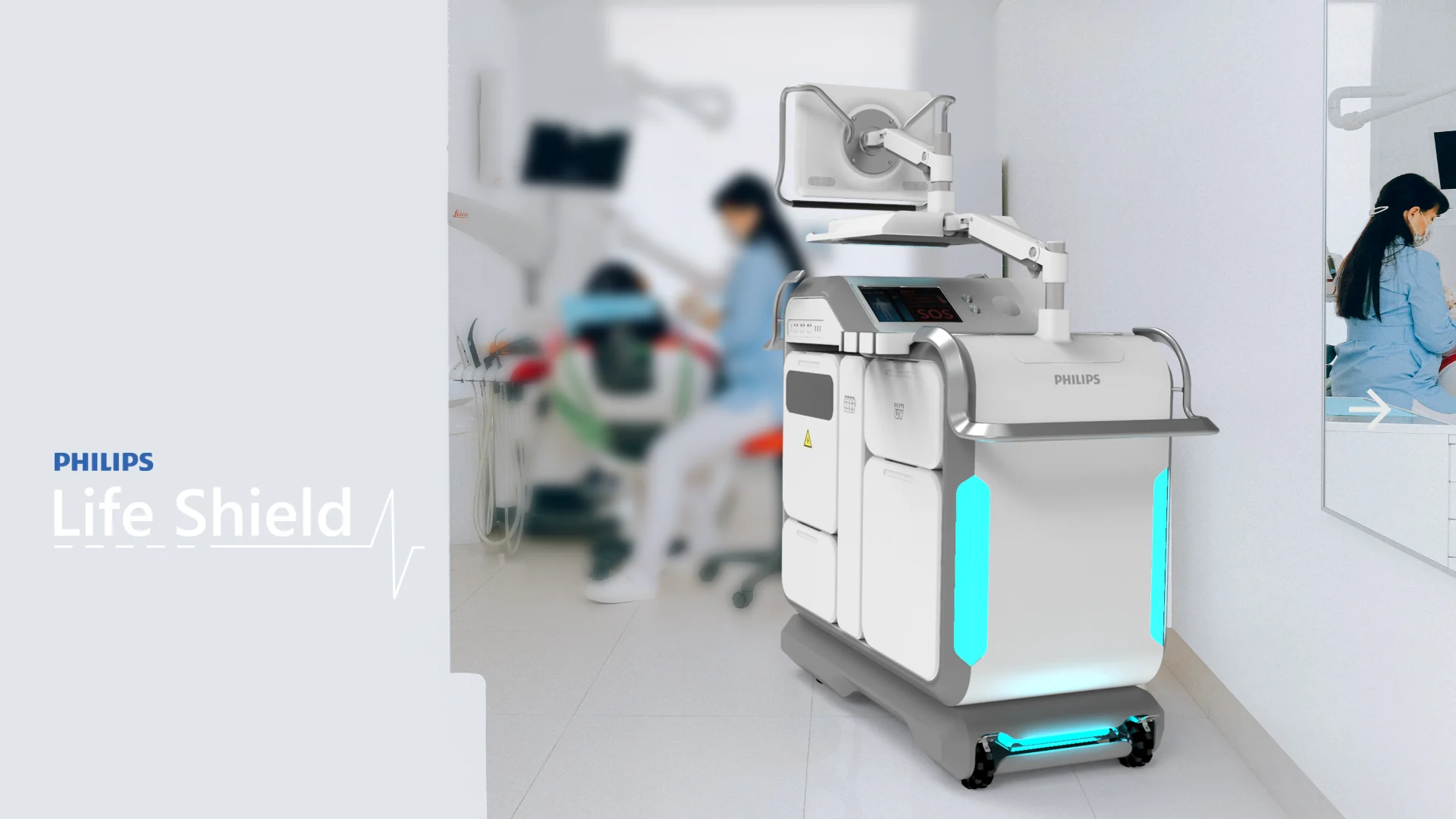
The final form combined a compact central body, side-access modules, an elevated work surface, an articulated display, lower mobility hardware, and illuminated vertical elements.
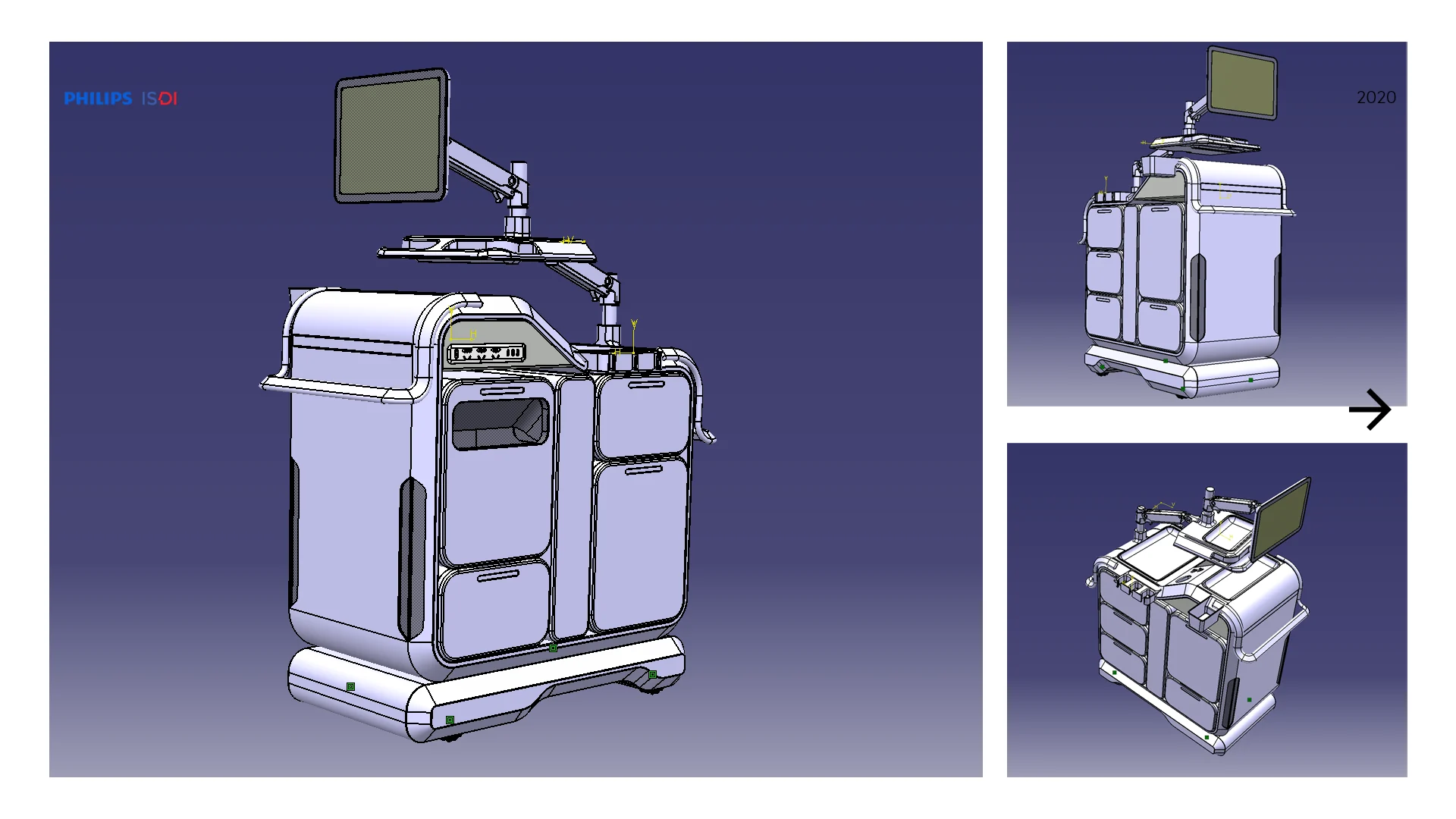
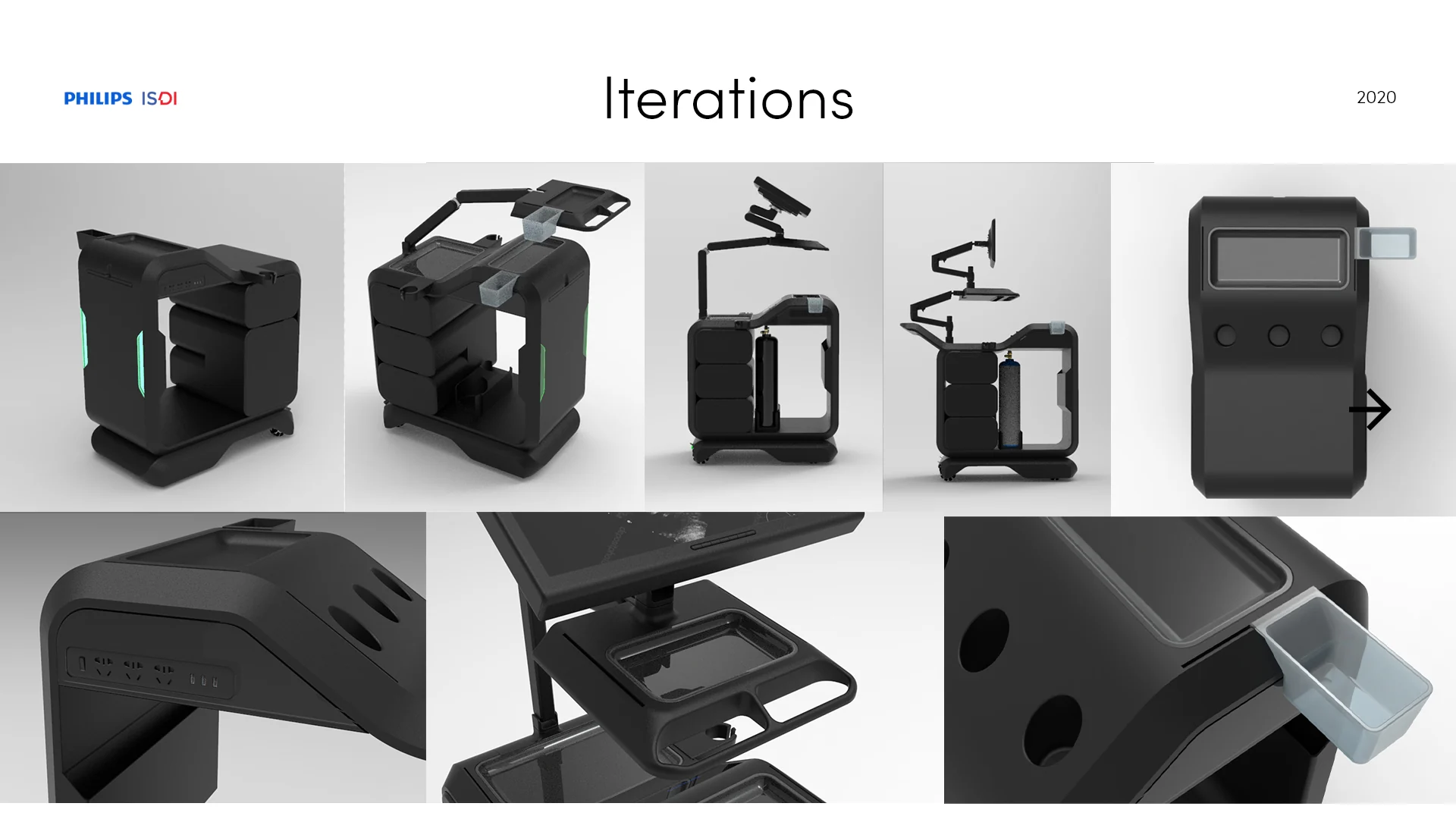
The documented iterations show changes to the body architecture, handles, work surface, screen support, modules, and detailed attachments. The deck records visual development, but not a tested evaluation of those iterations.
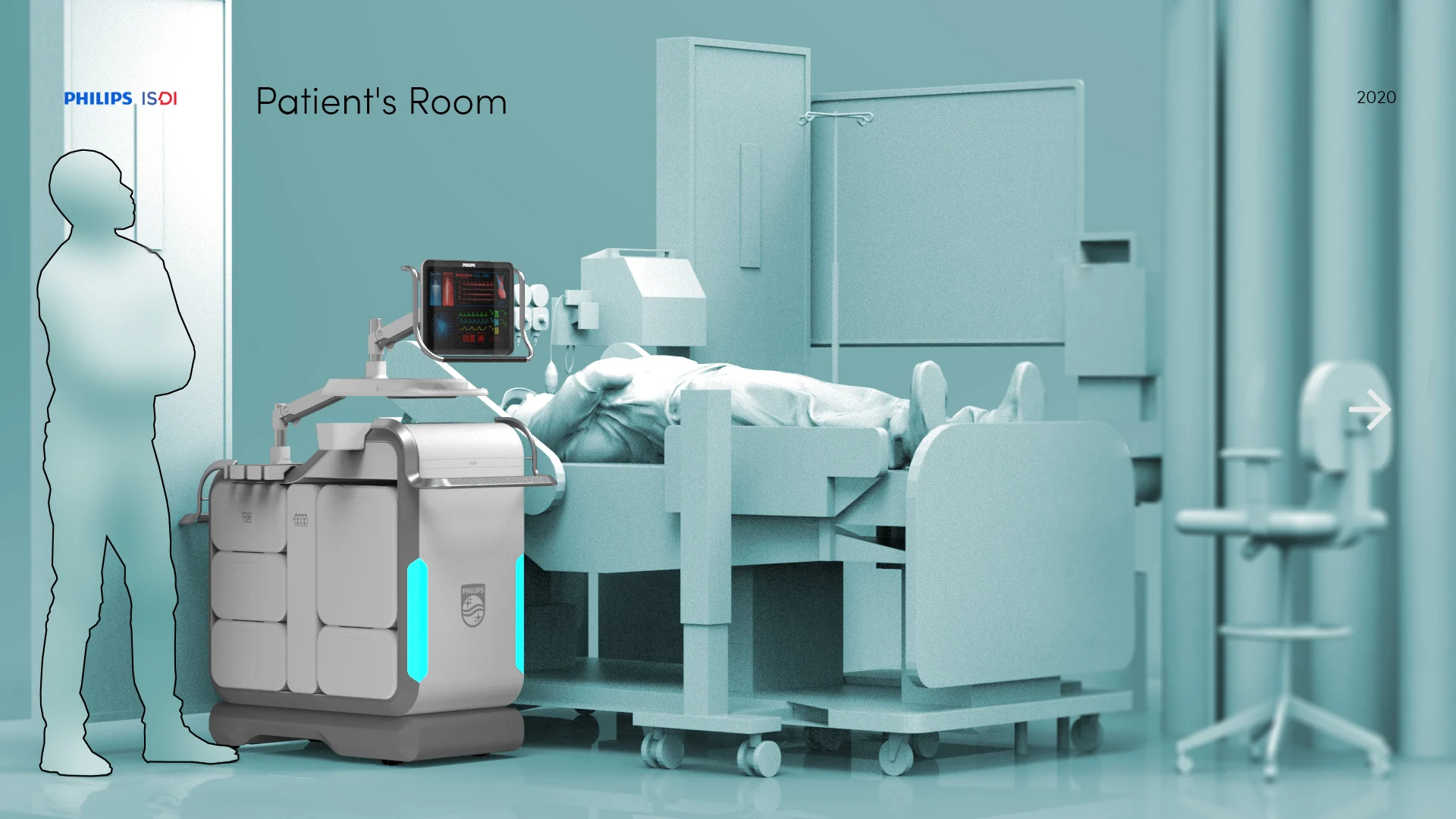
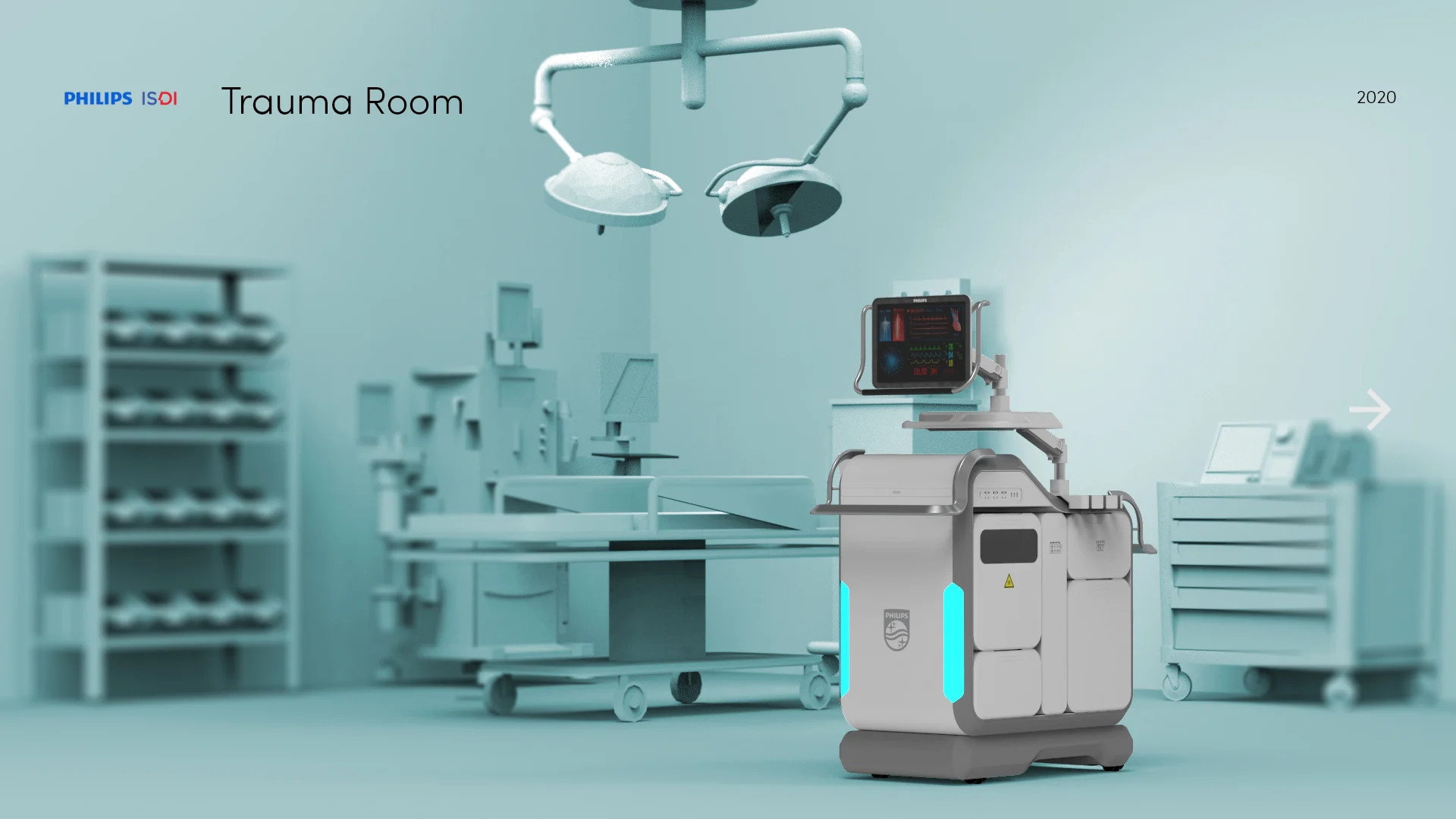
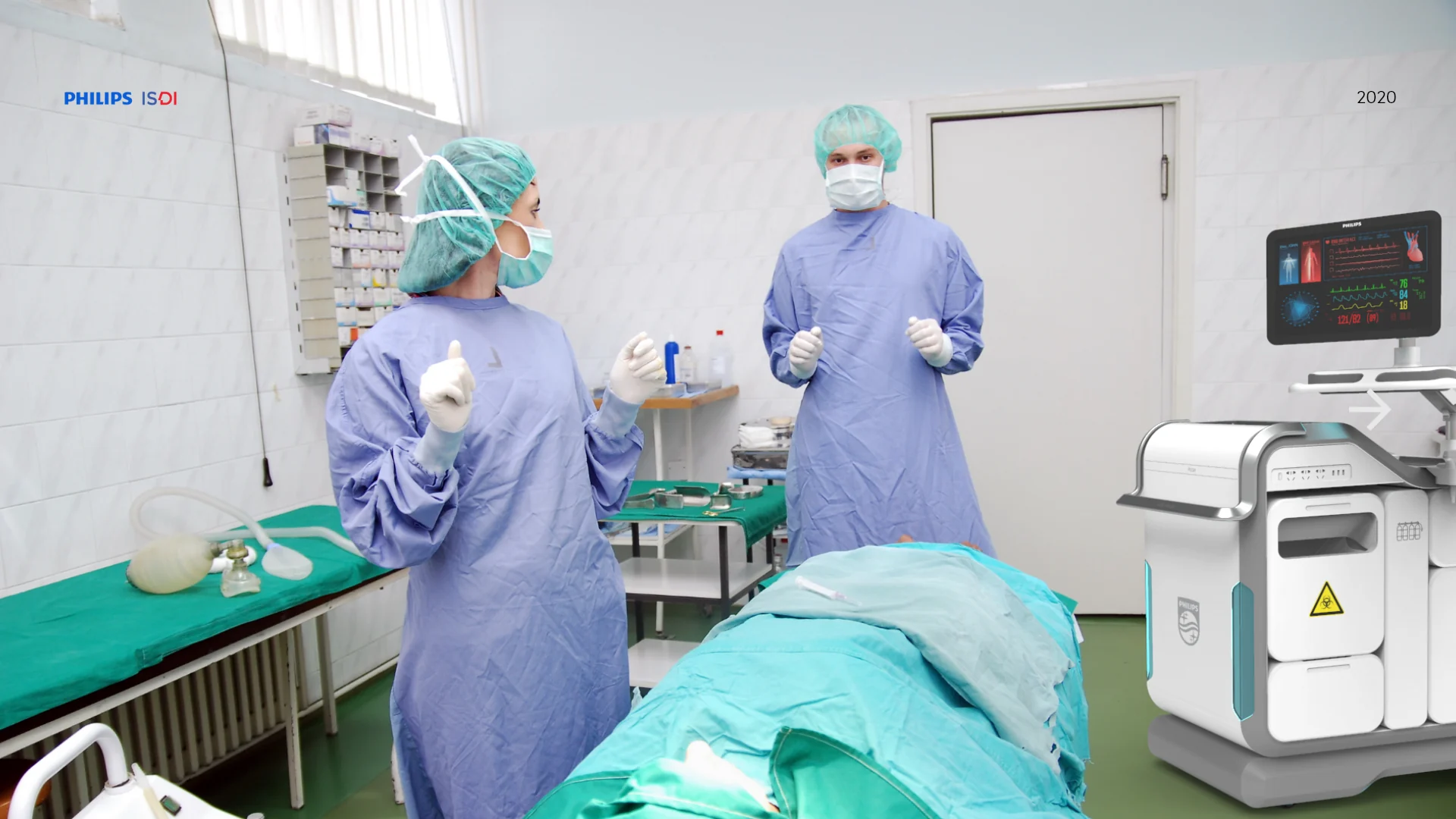
Contextual renders positioned the cart beside a patient bed and within an emergency or operating environment. These images communicate intended scale and access; they are conceptual composites, not photographs of deployment.
The feature walkthrough describes design intent, not clinically or technically validated performance.
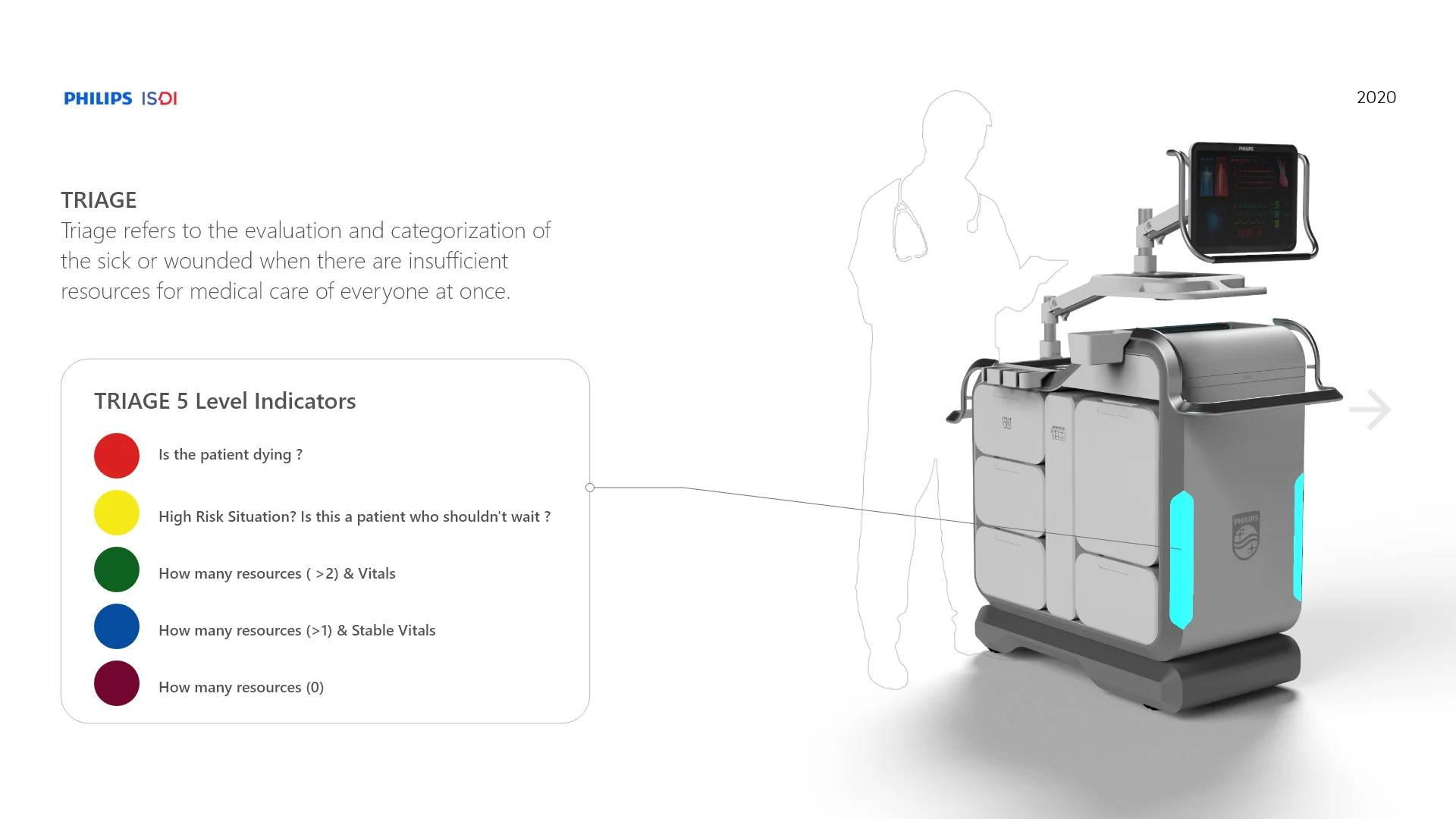
The cart proposed five colour-coded triage states based on urgency, risk, resource need, and vital stability. The deck did not document validation of this decision logic.
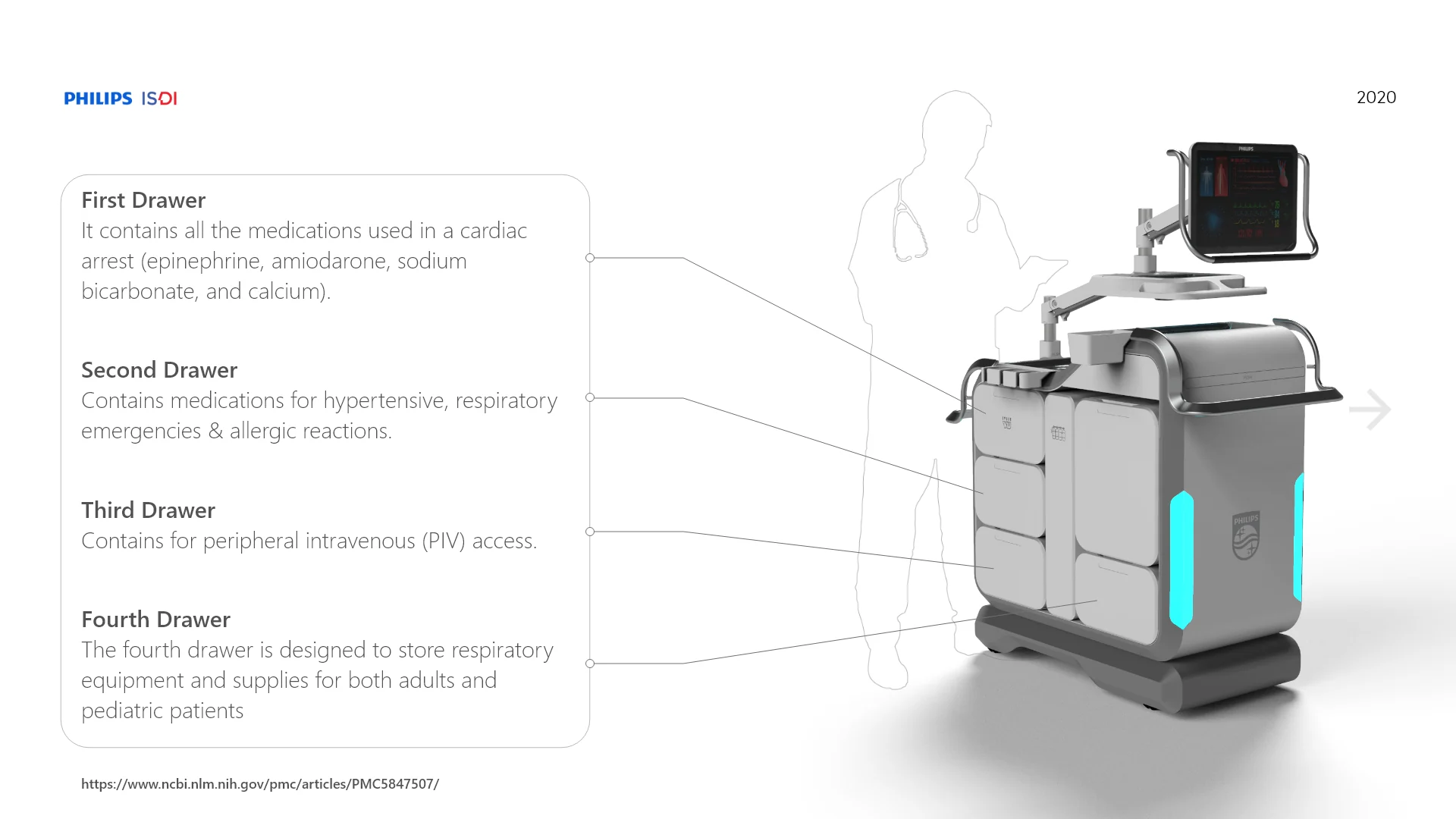
Four drawers were organised around cardiac-arrest medication, hypertensive and respiratory emergencies, peripheral intravenous access, and adult or paediatric respiratory supplies. The original slide linked to an NCBI-hosted crash-cart reference.
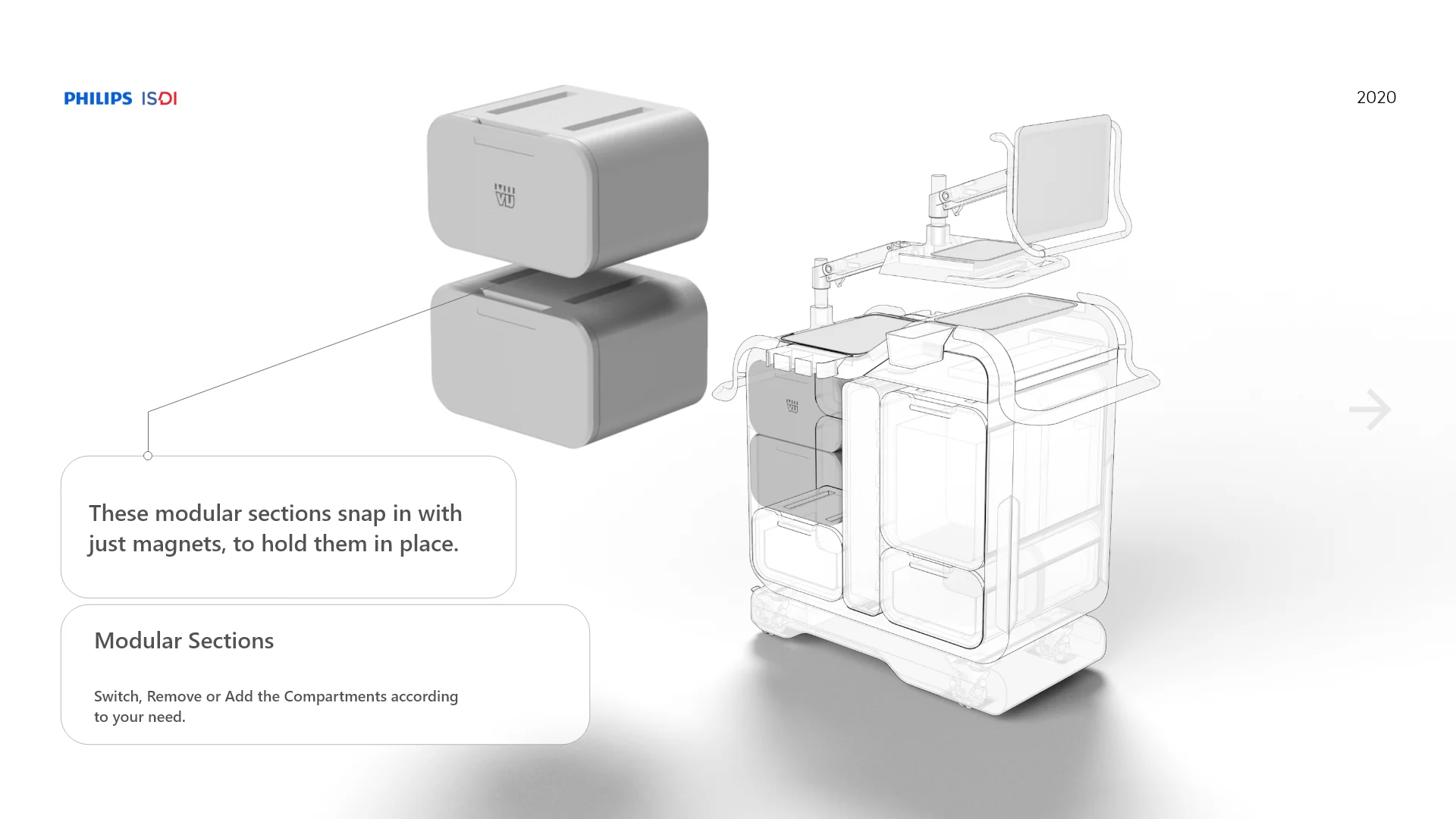
The proposal used removable side modules held in place by magnets so compartments could be switched, added, or removed. This mechanism was illustrated but not physically tested in the supplied evidence.
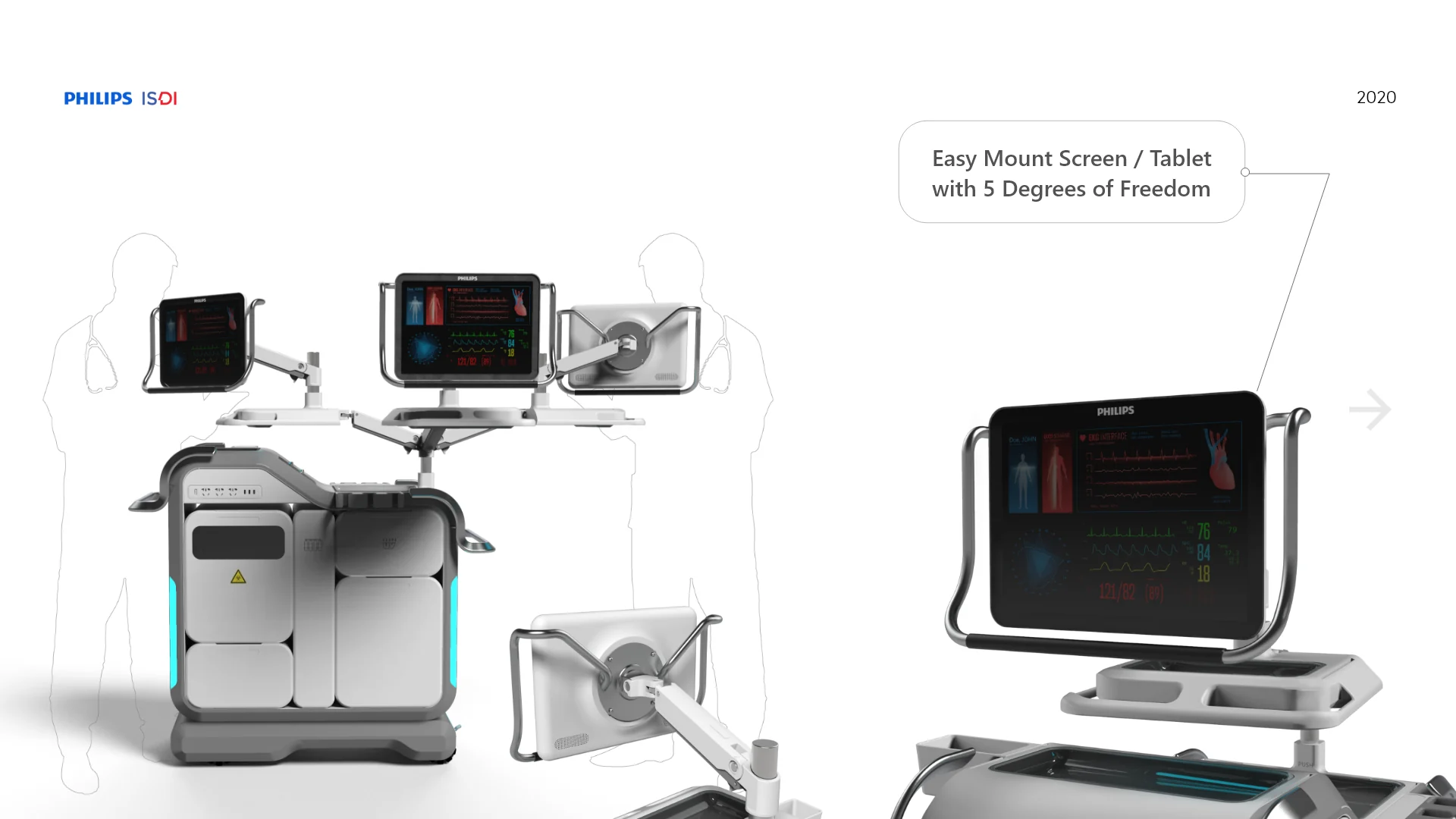
The screen or tablet mount was designed with five degrees of freedom to support different viewing and working positions.
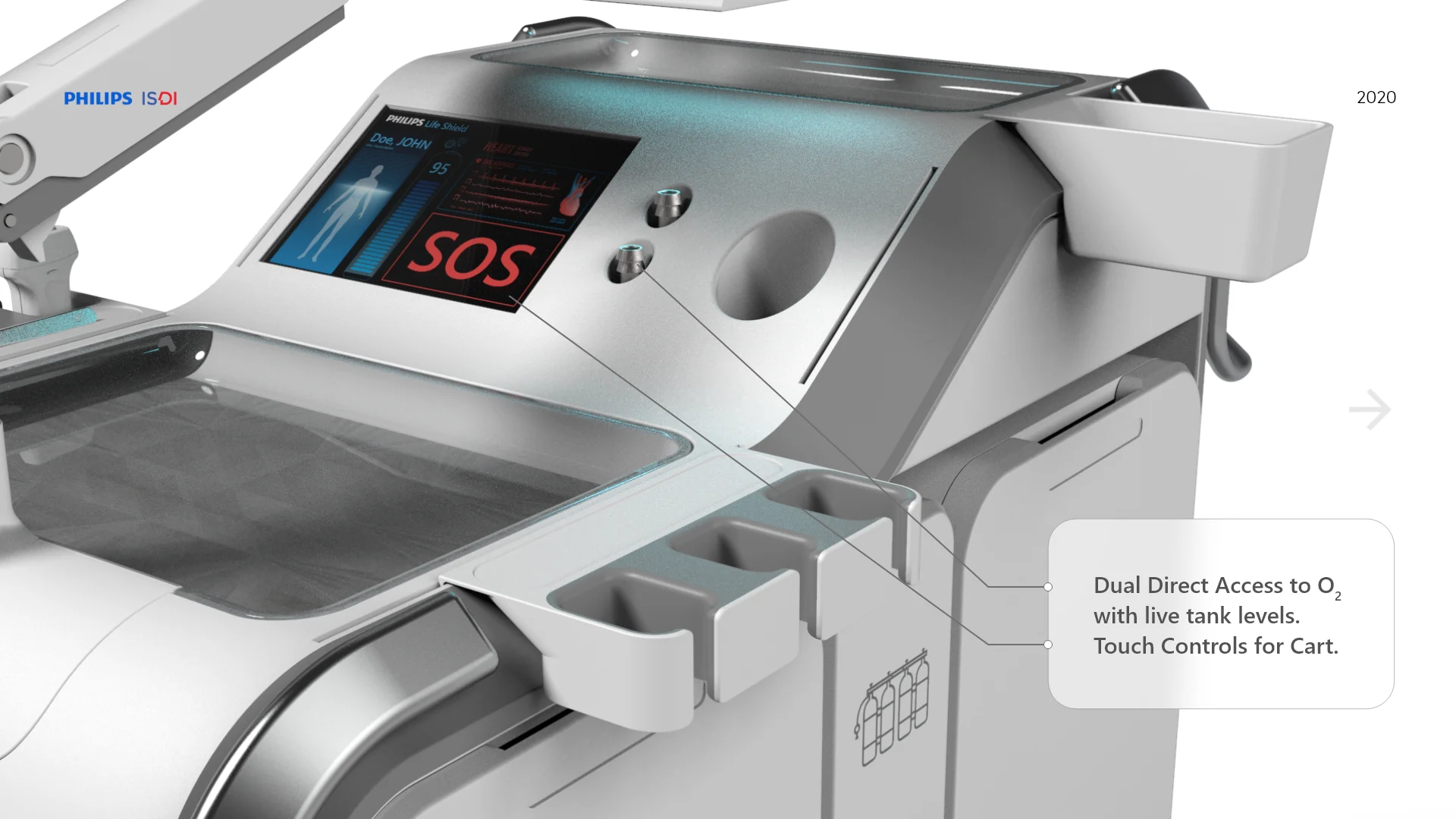
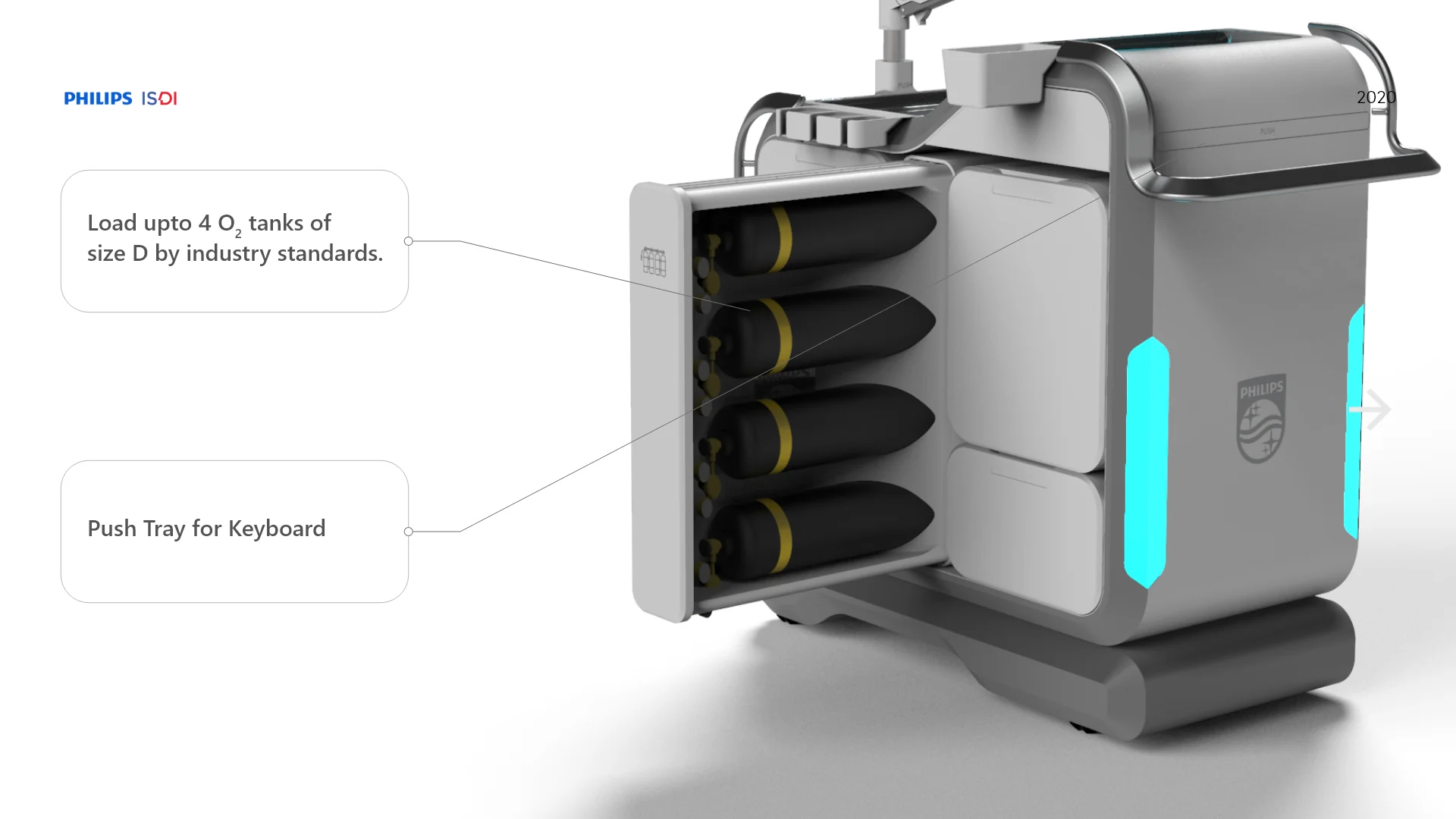
The cart proposed dual direct access to O2 cylinders, live tank-level visibility, and touch controls placed in the upper work area.
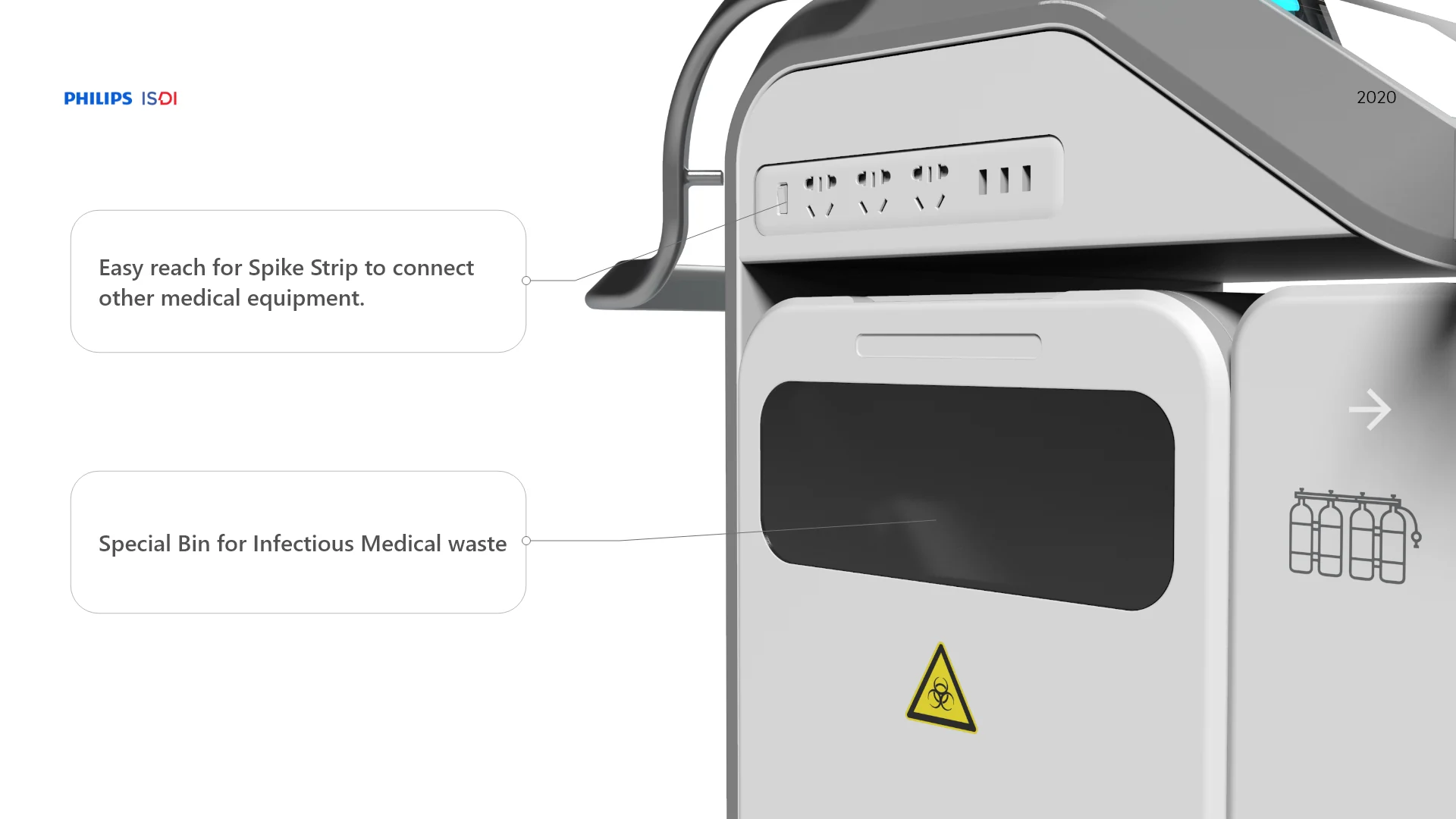
An accessible power strip supported connections to other equipment, while a dedicated compartment was proposed for infectious medical waste.
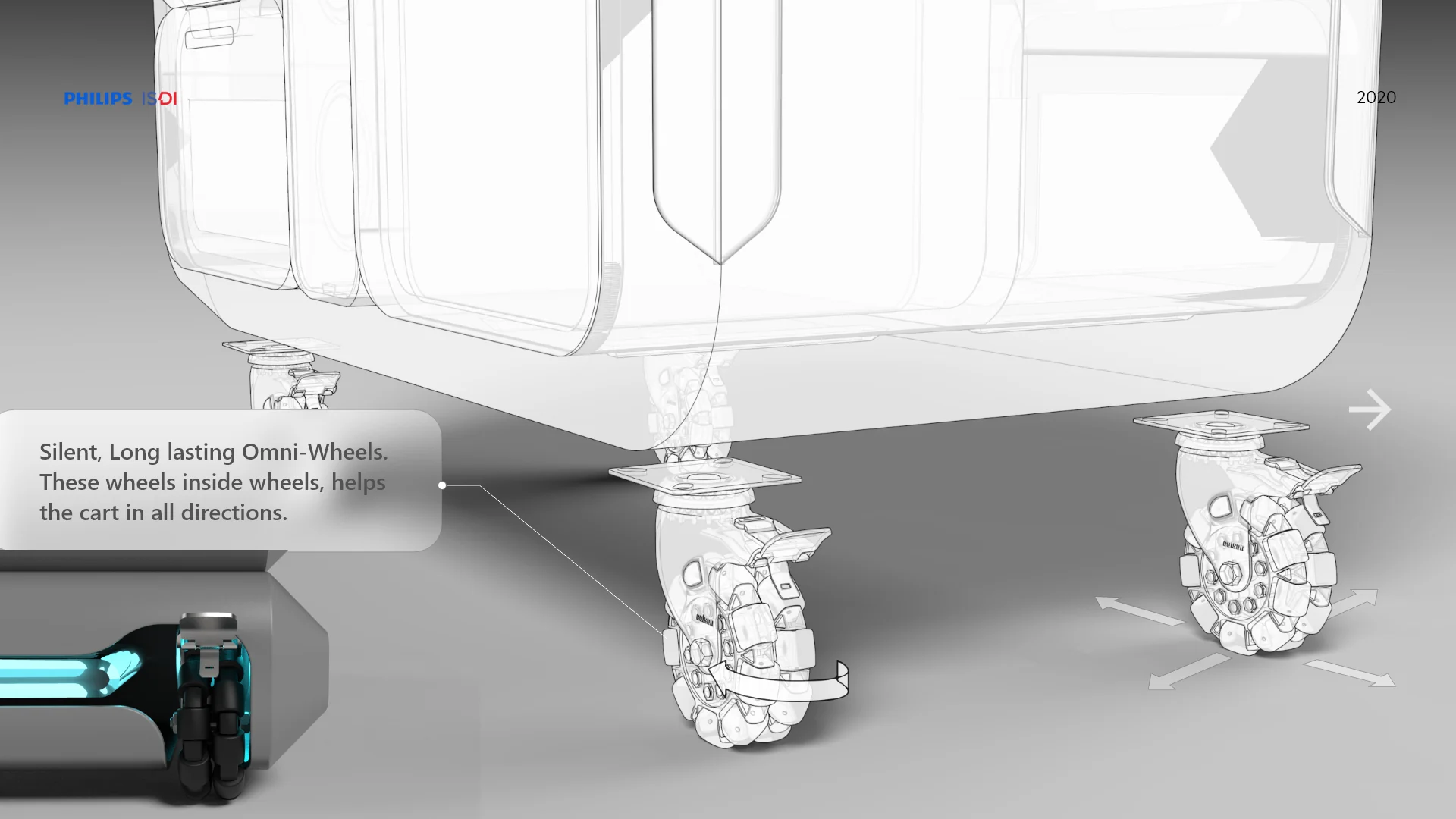
Multidirectional omni-wheels were proposed to help the cart move in constrained spaces. Claims of silent operation and long service life were design intentions and were not validated in the supplied material.
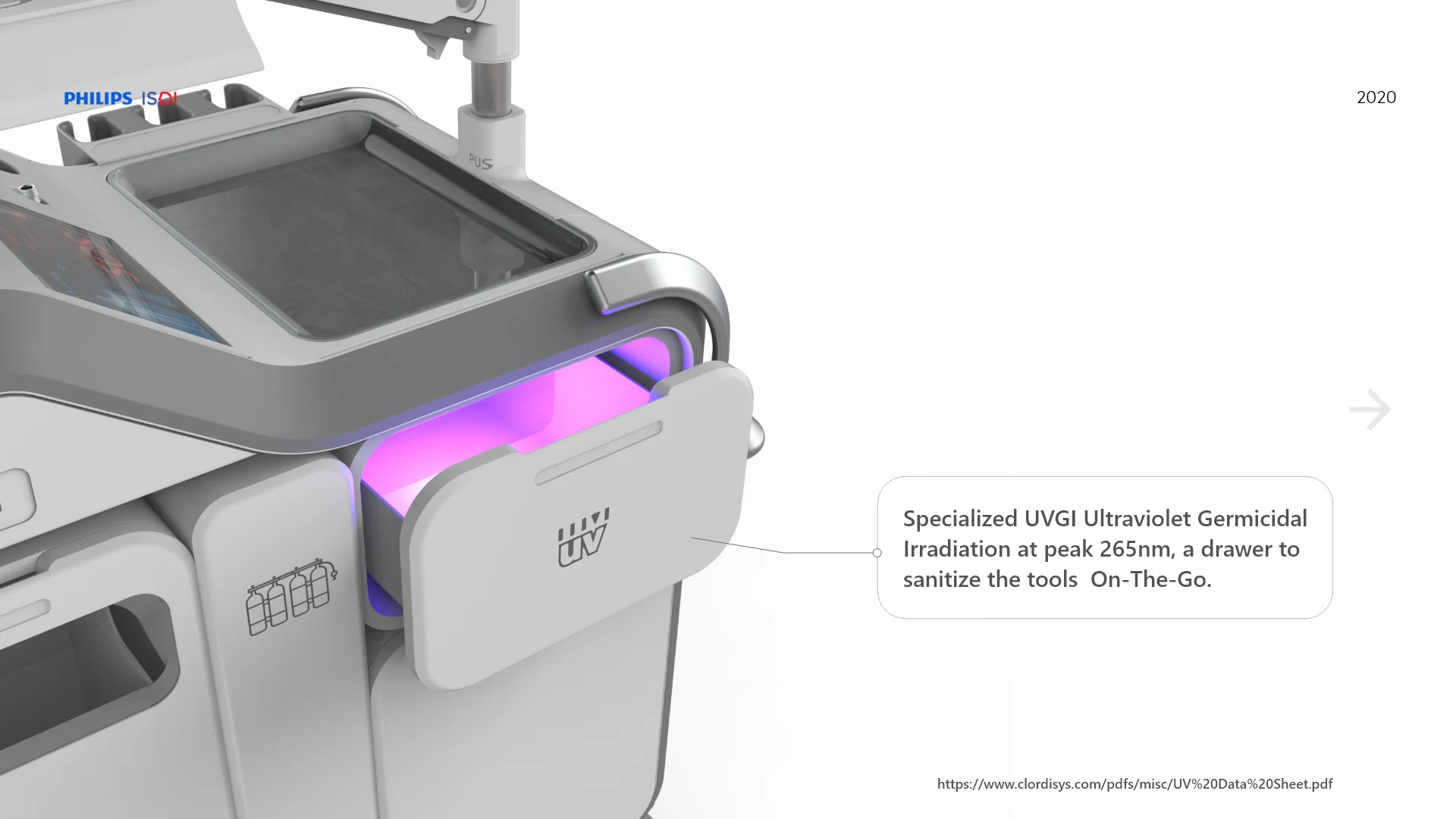
The concept included a UVGI drawer described in the deck as operating at 265 nm for on-the-go tool sanitation. The source slide linked to a commercial UV data sheet; no dose, cycle, material-compatibility, safety, or efficacy validation is documented, so this remains a proposed feature.
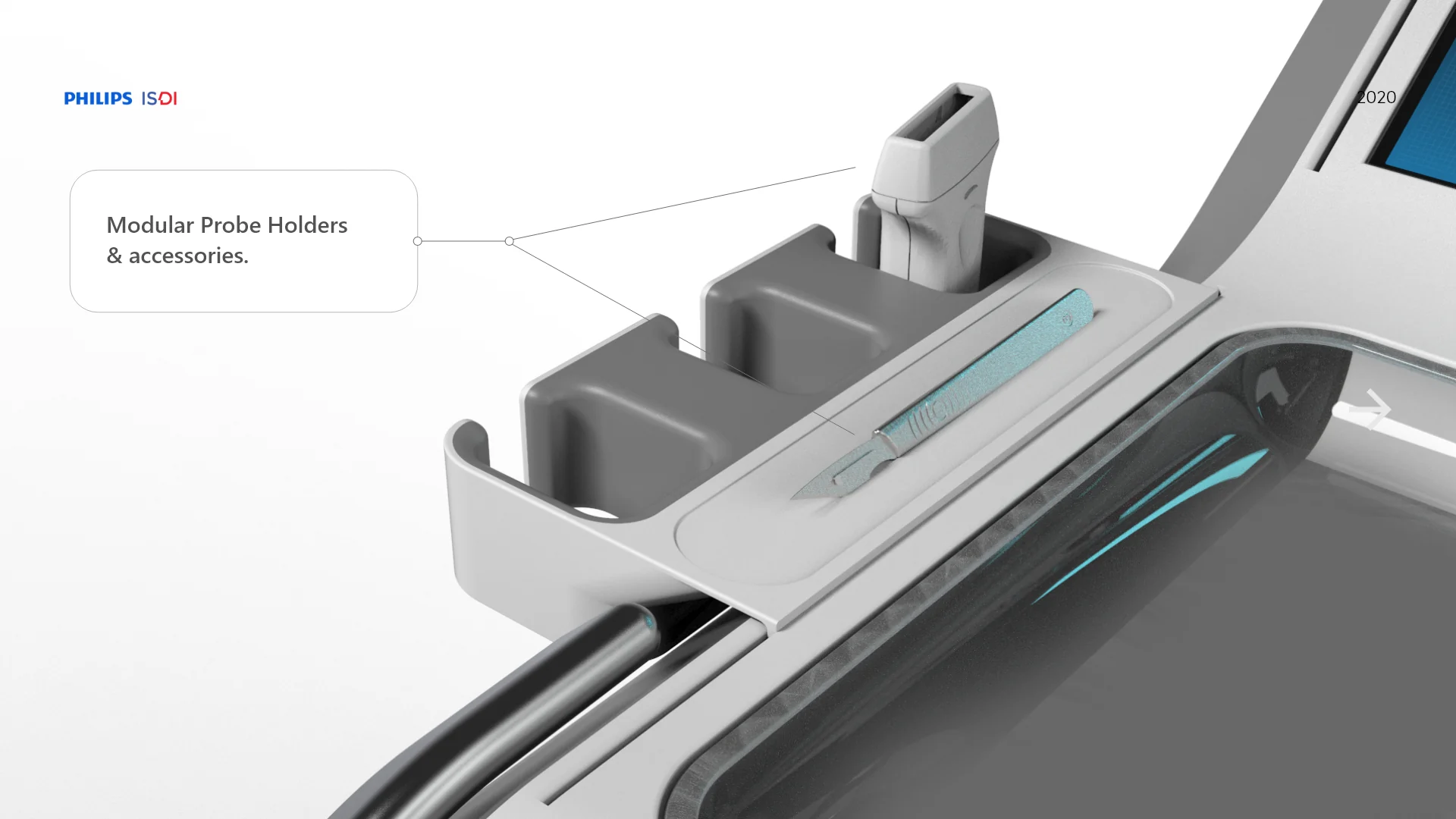
Modular probe holders and accessory storage were integrated along the product sides.
The rear volume was proposed to hold up to four industry-standard size-D O2 tanks, alongside a push-out keyboard tray. Capacity and handling were illustrated but not physically verified.
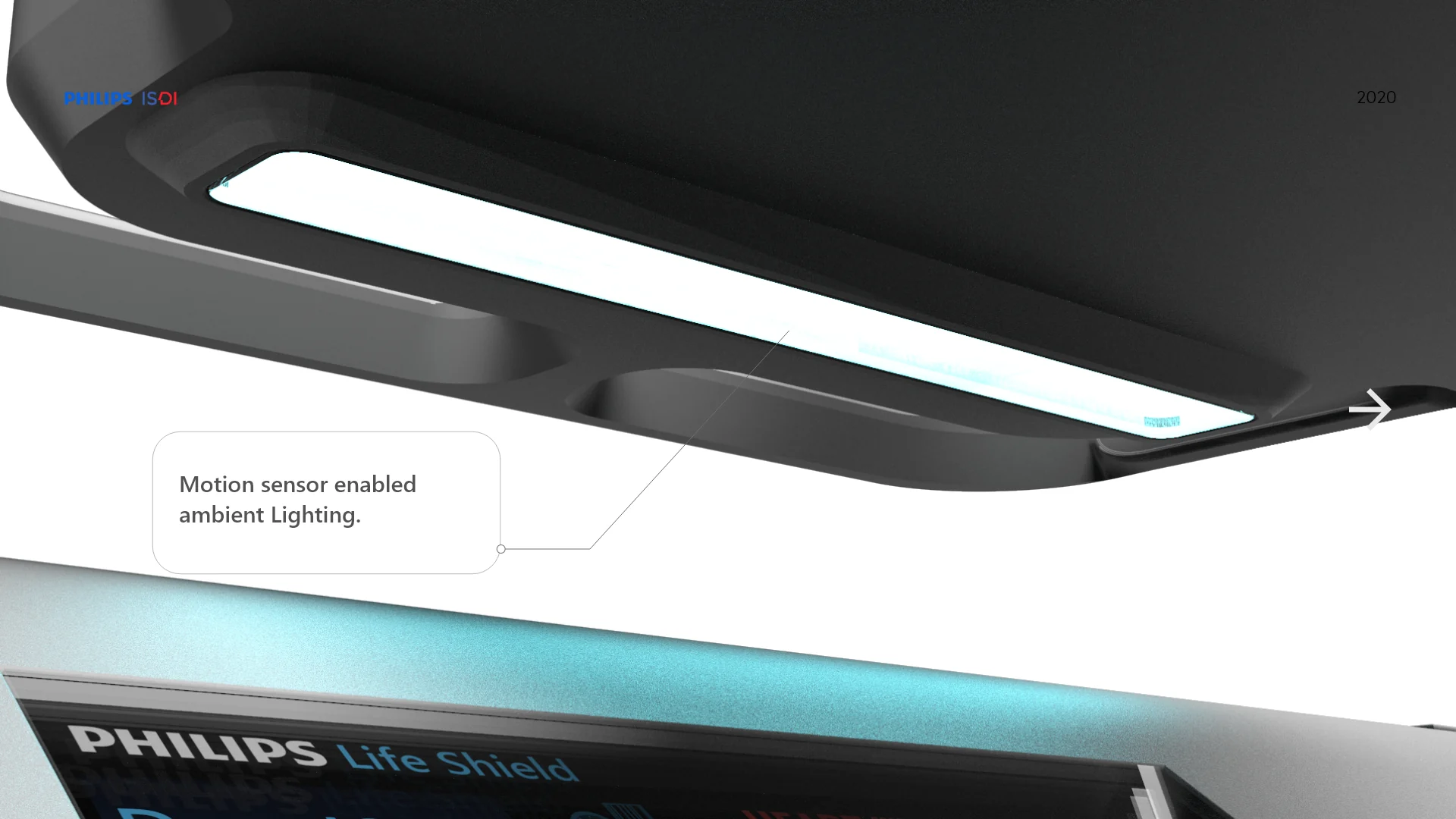
Motion-sensor ambient lighting was intended to make the cart easier to locate and read within the clinical environment.
The project delivered:
It did not establish a measured reduction in response time, clinical benefit, user acceptance, manufacturing feasibility, or commercial impact.
This case study intentionally separates documented project outputs from validated outcomes. The strongest evidence is the translation of workflow, spatial, product, stakeholder, and ergonomic research into a coherent industrial-design proposal. The main limitation is that no prototype study, clinician evaluation, engineering test, manufacturing development, or launch evidence was supplied.